

Manitoba Legislative Building Decorative And Symbolic Architecture
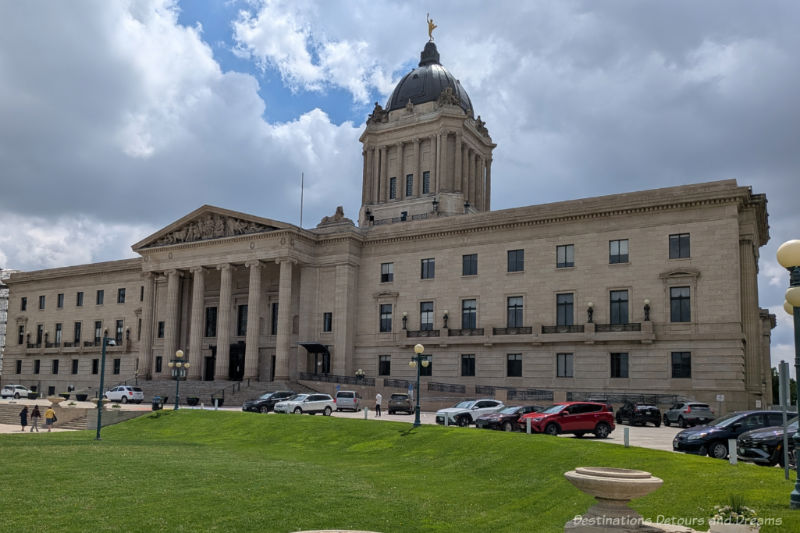
The Manitoba Legislative Building in Winnipeg, Manitoba, Canada features decorative and symbolic ornamentation incorporating Greek, Roman, and Egyptian design elements
The impressive Manitoba Legislative Building is full of decorative and symbolic ornamentation inside and out. The design incorporates Greek, Roman, and Egyptian architectural elements. The building houses the provincial legislative assembly, its committees and staff, and offices for government ministers and deputy ministers. Free guided tours are available.
Manitoba Legislative Building Construction History
This building is actually the third legislative building of Manitoba. The Manitoba Legislative Assembly began meeting in 1871 in a refurbished log structure owned by businessman A. G. Bannatyne. The building burned down two years later. The second building, which was first occupied in 1884, was located on the northeast corner of the current Legislative grounds. It was demolished in 1920, after the current building was constructed, to facilitate landscaping of the grounds.
In the early twentieth century, members of the government wanted to construct a building to serve as a symbol for the people of Manitoba. An architectural competition open to all architects in the British Empire was announced in 1911 with a prize of $10,000. Frank Worthington Simon of Liverpool had the design that won the contest.
Construction began in 1913 and experienced a number of delays and cost overruns. The outbreak of World War I resulted in shortages of materials and labour as well as increased prices. Building contractor Thomas Kelly fraudulently overcharged the Manitoba government with some of that money being kicked back to the Conservative Party of Premier Rodmond Roblin. When this became public knowledge, Roblin lost power. Kelly fled to Chicago, but was extradited to Manitoba where he faced trial and some jail time, after which he relocated to Kansas City and later California. The building officially opened in July of 1920 at a total cost of over nine million dollars, a significantly larger amount than the originally-planned two million.
Manitoba Legislative Building Exterior
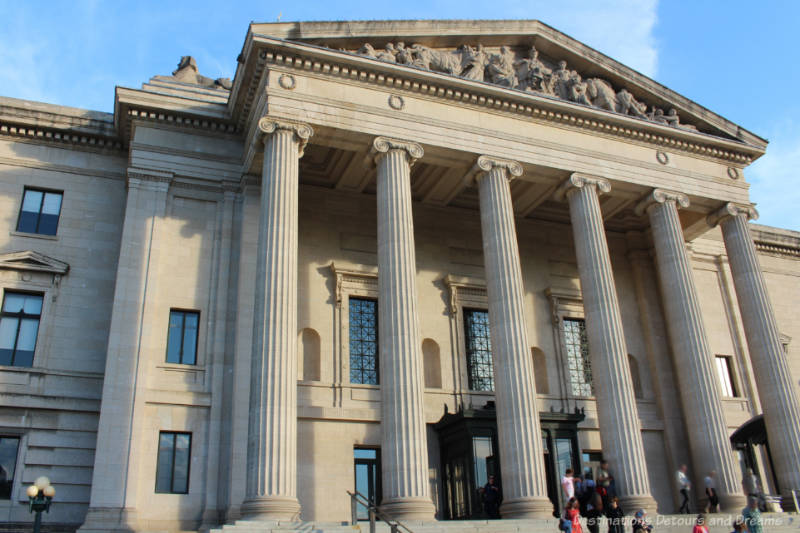
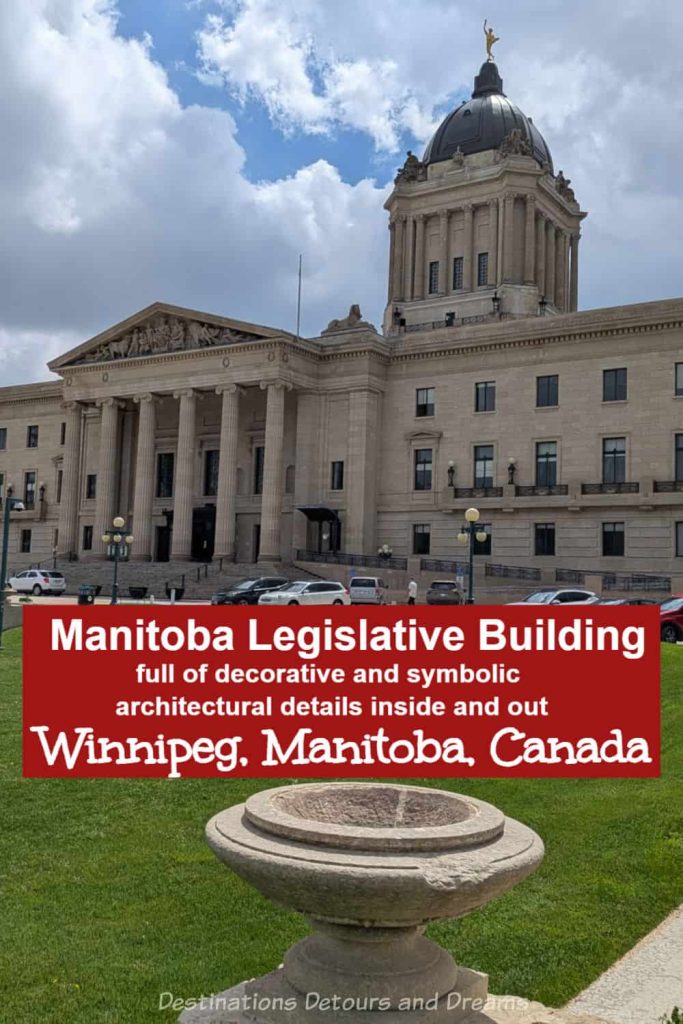
The building’s symbolism and ornamentation can be found as soon as you approach the neo-classical building. A wide staircase leads up to ionic columns fronting the entrance. (Note there is a ramp to the side for those who cannot manage stairs.) The exterior walls and many of the interior walls are constructed of Tyndall limestone, which is quarried at Garson, Manitoba.
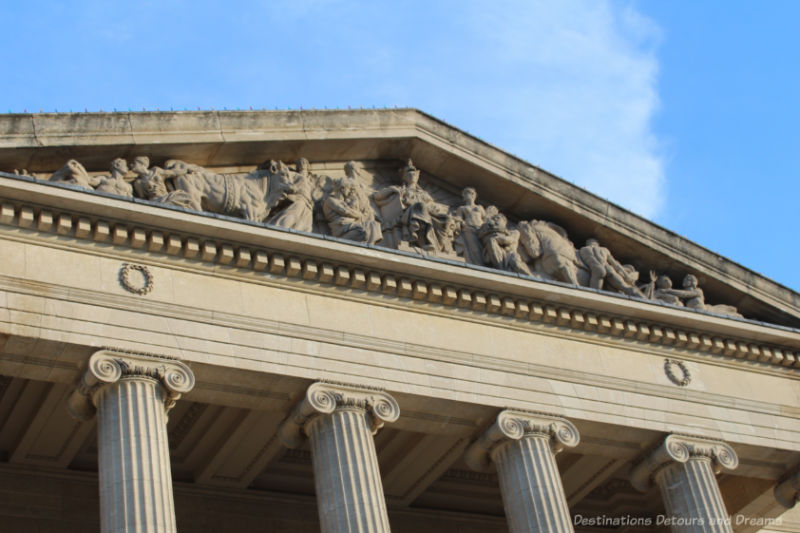
The triangular Pediment above the columns symbolizes the ideas of tolerance, justice, and hard work. Two sphinxes sit on either side of the Pediment.
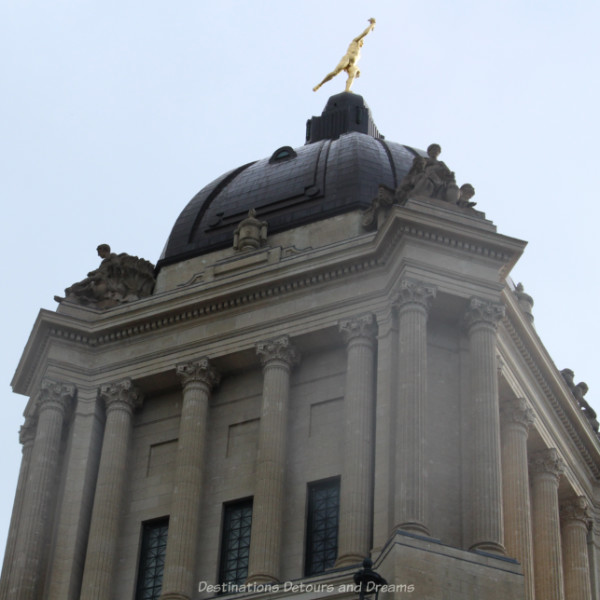
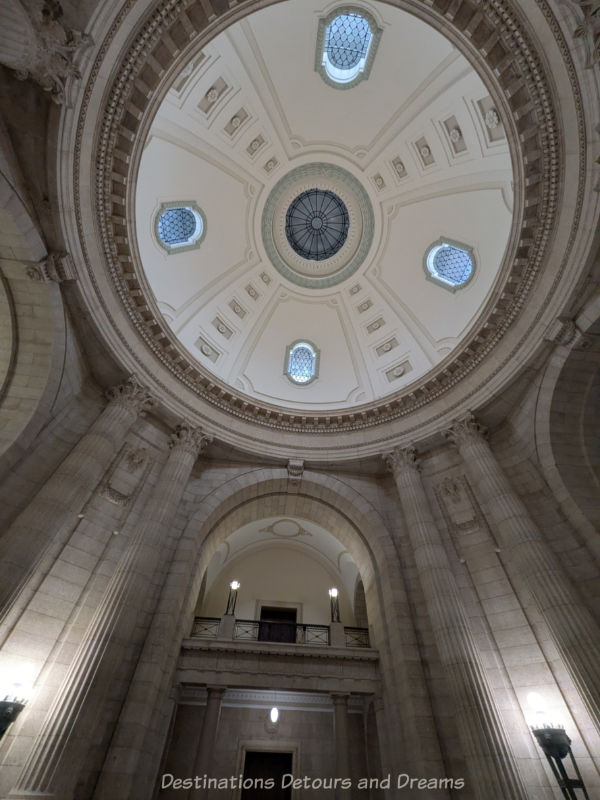
Twenty-four Corinthian columns run around the base on the building’s dome. Four sculptural groups above those columns just below the dome represent Industry, Art, Agriculture, and Science/Learning. Atop the dome is the Golden Boy, perhaps the most iconic feature of the building. Standing 5.25 meters tall (17.2 feet) and facing north, the figure carries a sheaf of grain in his left hand and a torch in his right. The statue was sculpted by Georges Gardet of Paris and cast at the Barbedienne Foundry in France. The foundry was partially destroyed during World War I, but the statue was not harmed. As a precaution, it was moved to Le Havre, where it was placed in the bottom of a freight steamer. That steamer was commandeered for use in the war before the statue could be shipped to North America. The steamer made two trips across the Mediterranean Sea and at least two Trans-Atlantic voyages, in which the statue was used as ballast on the ship, before the statue was unloaded in North America and sent to Winnipeg via train in 1919.
The bronze statue, whose official name is Eternal Youth and Spirit of Enterprise, had no gold covering, but it gained the nickname “Golden Boy” because of the way it reflected the light. Over time patina built up. It was cleaned and revarnished a couple of times. In 1951, the statue was painted gold. That paint lasted only three months. Gold leaf was then applied to the statue. In 2002, the statue was removed for structural repairs, regilded, and reinstalled later that year.
Manitoba Legislative Building Interior
Grand Staircase
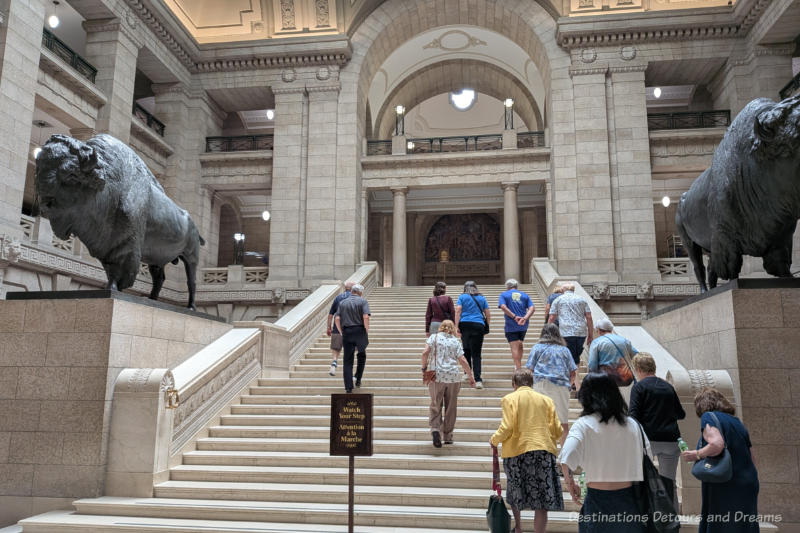
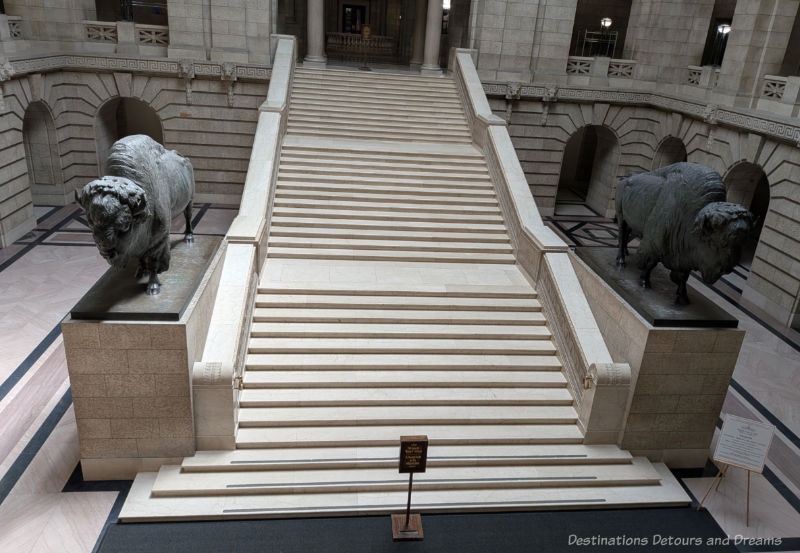
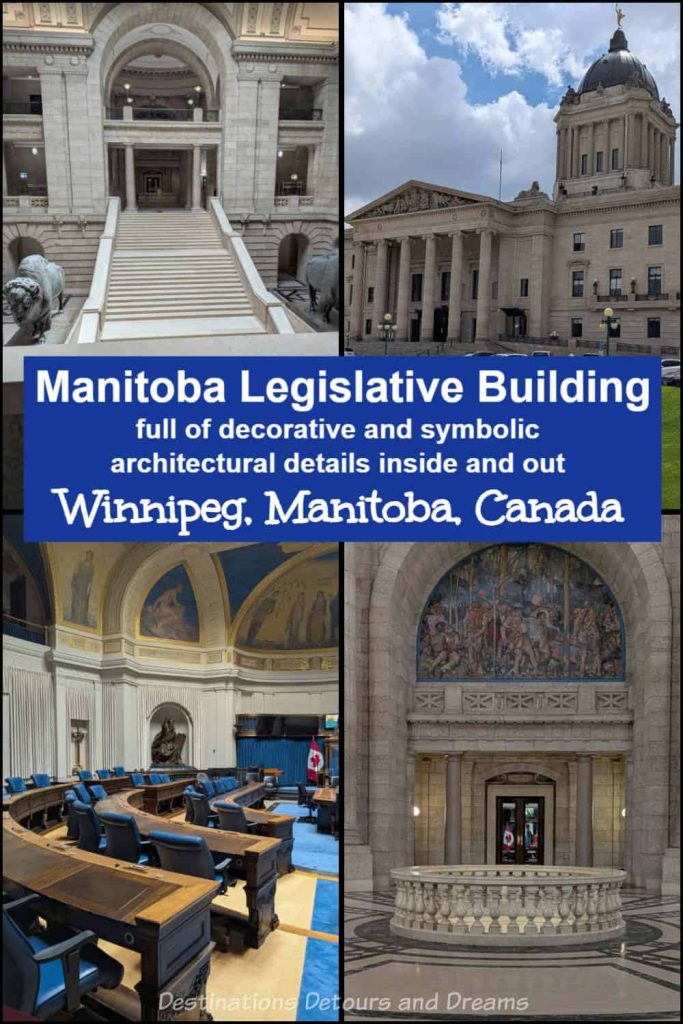
The Grand Staircase, the first thing you see upon entering the building, creates a palatial atmosphere. Two life-sized bison statues flank either side of the staircases. The bison is one of two mammal emblems of Manitoba. The other is the polar bear. The statues, weighing 2,268 kilograms (5,000 pounds) each, were designed by Georges Gardet, the designer of the Golden Boy, and cast in New York. It is said that in order not to scratch the marble floors when the bison were installed, the bison were placed on slabs of ice cut from the frozen Red River and slid into the building.
Most of the marble in the floors throughout the building came from the United States, but there are a few places where Italian Botticino marble, considered to be the finest marble in the world, was used. The Grand Staircase is one of those.
Rotunda and Pool of the Black Star
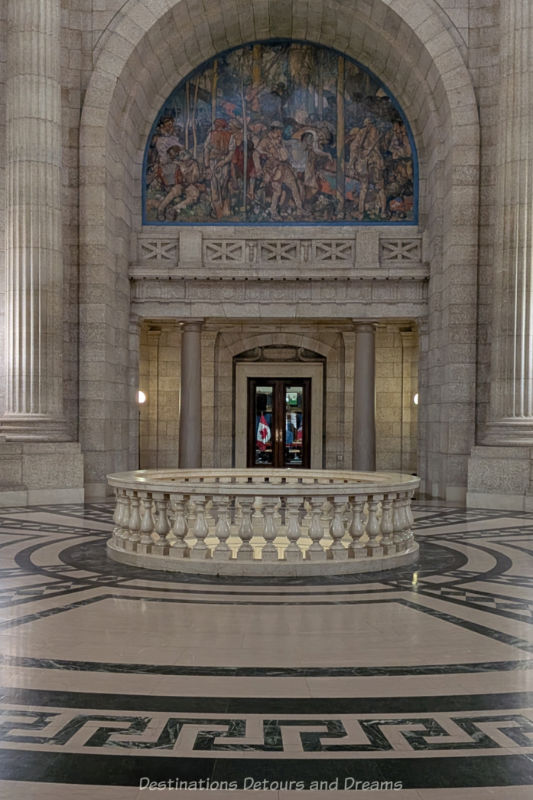
The Rotunda at the head of the Grand Staircase is an anteroom leading to the Legislative Assembly. It sits under the beautifully decorated dome. The design in the floor is the continuous Greek key, symbolic of the eternal quest for knowledge.
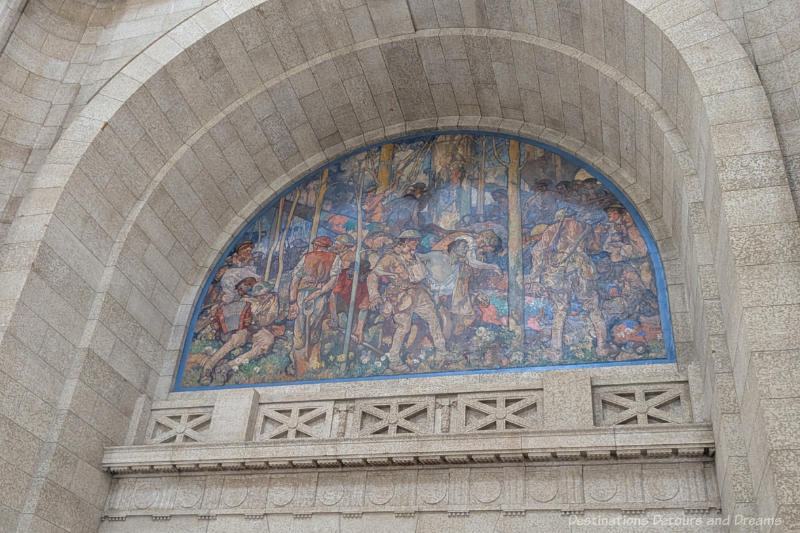
Above the entrance to the Legislative Assembly you’ll find the mural The Allegory of Canada’s War Record by Frank Brangwyn of London, England.
A circular opening in the floor in the centre of the Rotunda provides a view of the Pool of the Black Star on the floor below. The Pool of the Black Star features an eight-pointed star in alternating solid black and marbled black that represent the altars of the ancient Greeks. The Pool of the Black Star is perfectly centred under the opening, but as you walk around the limestone railing and look down, it always appears to be closer to whereever you are standing. It is rather dizzying.
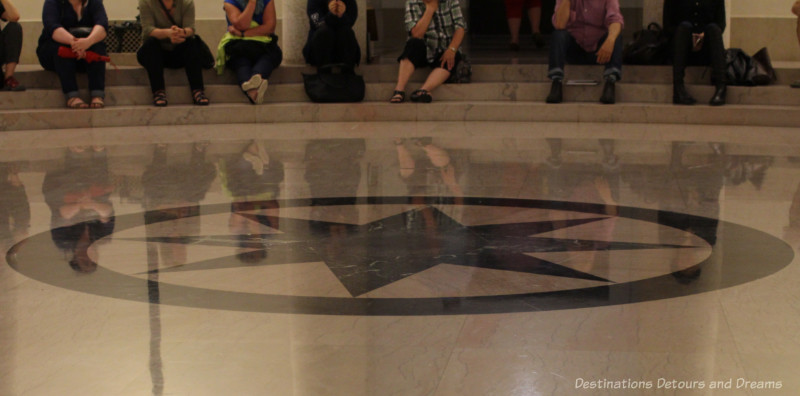
There are special acoustics associated with the Pool of the Black Star. Sounds from the building converge at its centre. When you stand there and whisper, you hear your voice boom.
Legislative Assembly and The Mace
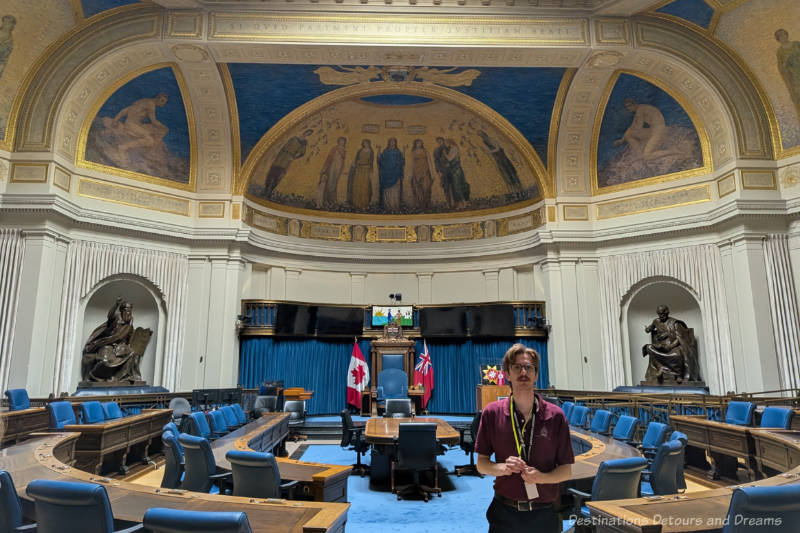
Manitoba currently has 57 elected Members of the Legislature (MLAs). The political party that elects the most Members forms the Government. Its leader becomes the Premier. The party with the next largest number of elected members forms the Official Opposition. As in most parliamentary systems based on the British model, the Government sits on the right of the Speaker, whose chair is at the front of the room, while the Official Opposition sits to the left.
Manitoba’s Assembly Room is unique among Canada’s provincial legislatures in that the Members’ benches form a horseshoe shape. The original desks and chairs are hand carved of walnut with inlaid ebony.
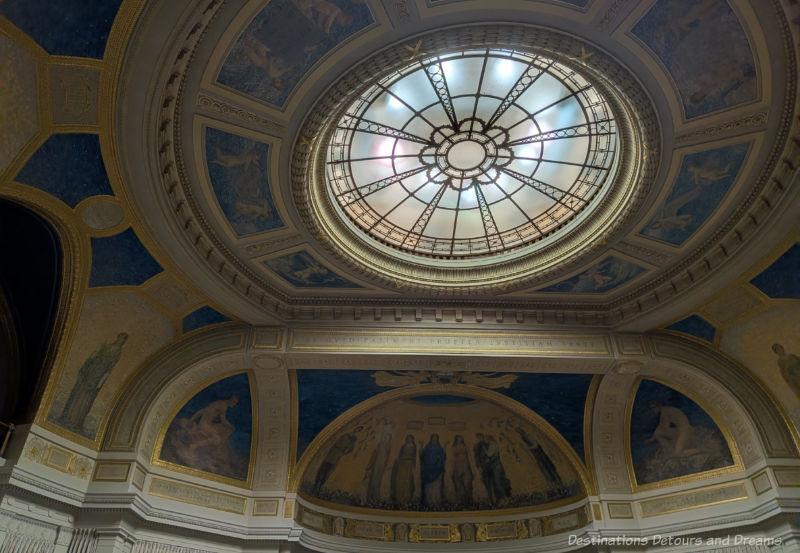
There are paintings and murals almost everywhere you look on the walls and the ceiling, all of it rich with meaning. Justice is portrayed as an unveiled woman supported by figures representing wisdom and knowledge. Five panels bear the names of great lawmakers in history. Cherubic figures represent the evolution and laws and legislation. Bronze statues represent Moses, the Hebrew prophet, teacher, and leader, and Solon, the Athenian politician and legislator. And there is much more. The tour guide highlights and explains key symbols, but I think if they were to explain every art element in the room, there would be no time left to look at anything else in the building.
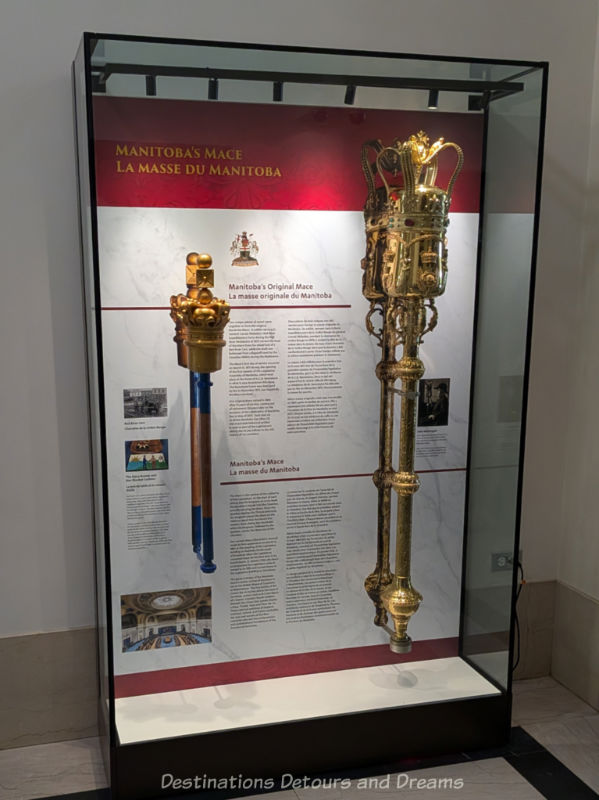
The tour guide also talks about the seating arrangements in the Assembly room and the processes followed. When each session begins, the Speaker enters the chamber followed by the Clerks of the Legislative Assembly and preceded by the Sargeant-at-Arms bearing the Mace, the symbol of authority of the Legislature. The Mace is set on a royal blue cushion on a table if the Speaker is presiding or a floor rack under the table if the Speaker is absent. When the assembly is not in session, the Mace is stored in a cabinet in a hallway known as the Speaker’s Gallery because it contains portraits of past Speakers. The original Mace, which was retired in 1884, is stored beside it.
Fossils and Art
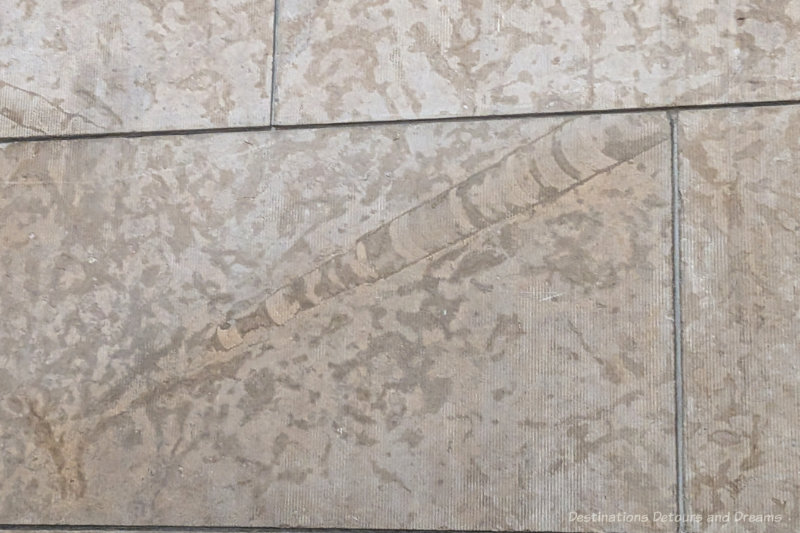
Tyndall Stone, used for many of exterior and interior walls, is a form of mottled, cream-coloured dolomitic limestone of the Late Ordovician age (about 450 million years old). A feature of the stone is the presence of fossils that give the stone its mottled appearance and offer a chance for fossil hunting in the building. The fossils may not be easily noticeable in all of the building’s walls, but in some spots they will be very obvious.
Another thing to look for on the walls when you get into hallways off the main area is art. The Manitoba Government owns thousands of pieces of art and hangs it in its various buildings. Many of the pieces in the Legislative Building are in offices and rooms you won’t see, but some are hung in those hallways.
Emblems, Symbols, and Symbolism
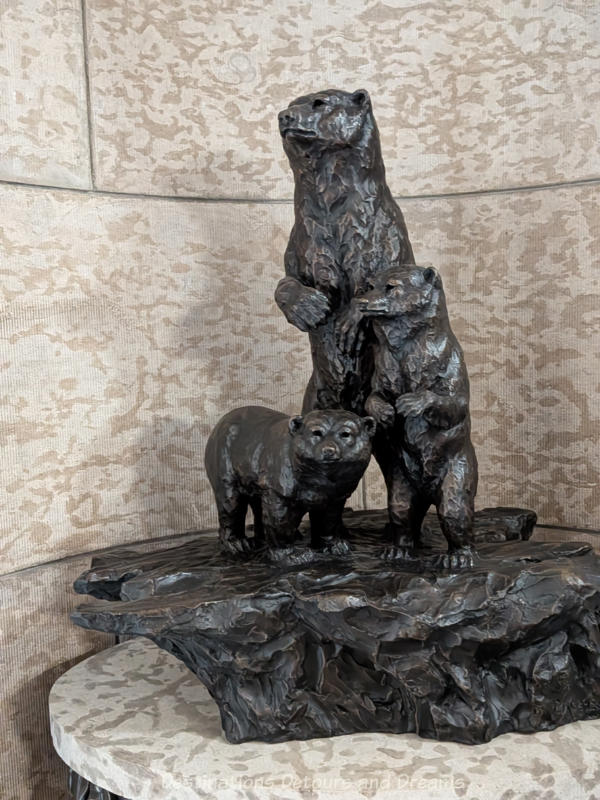
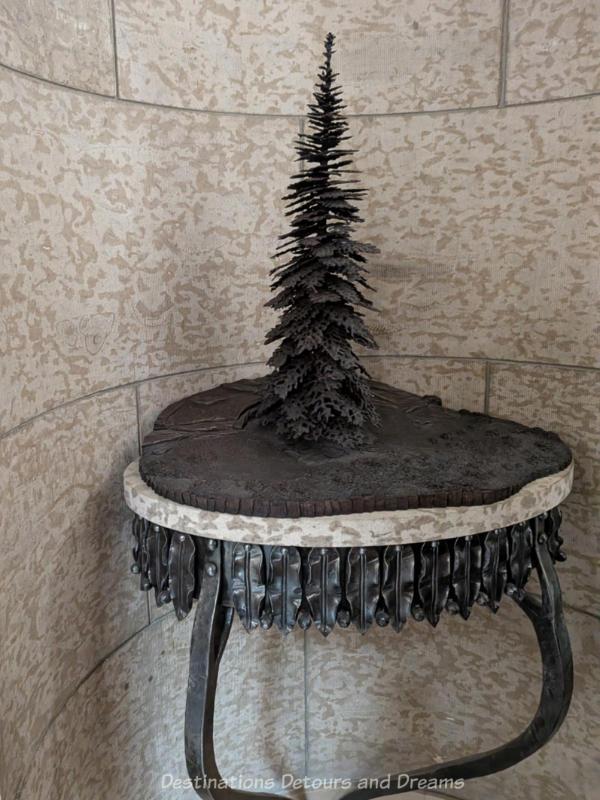
As you go through a tour of the building, your guide may point out a number of sculptures set into alcove shelves that depict emblems of Manitoba.
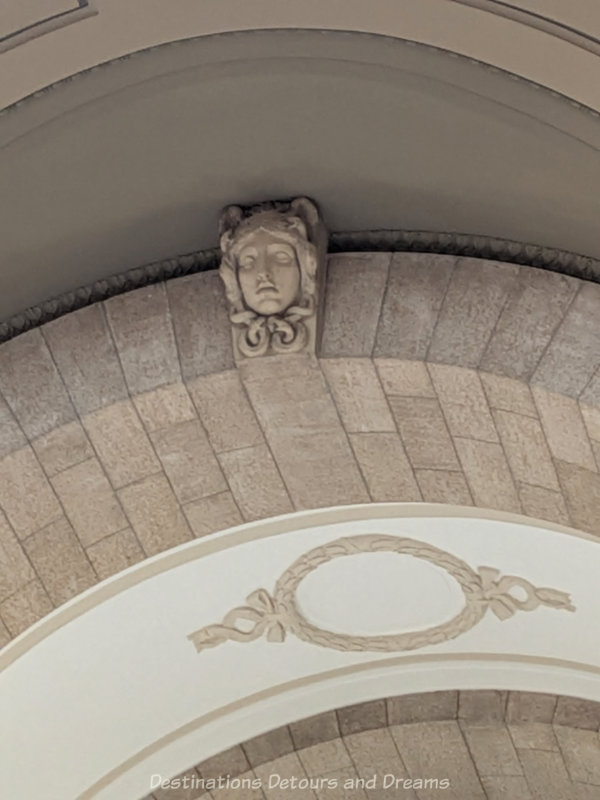
The architecture of the building itself includes many Greek, Roman, and Egyptian symbols. Guides point some of these out on their tours. A Medusa’s head, meant to guard against evil spirits and negative energy, adorns the keystone of the arch above the grand staircase. Athena is opposite her, carved in the keystone of the southern arch. Athena symbolizes wisdom, something we hope our governing body displays.
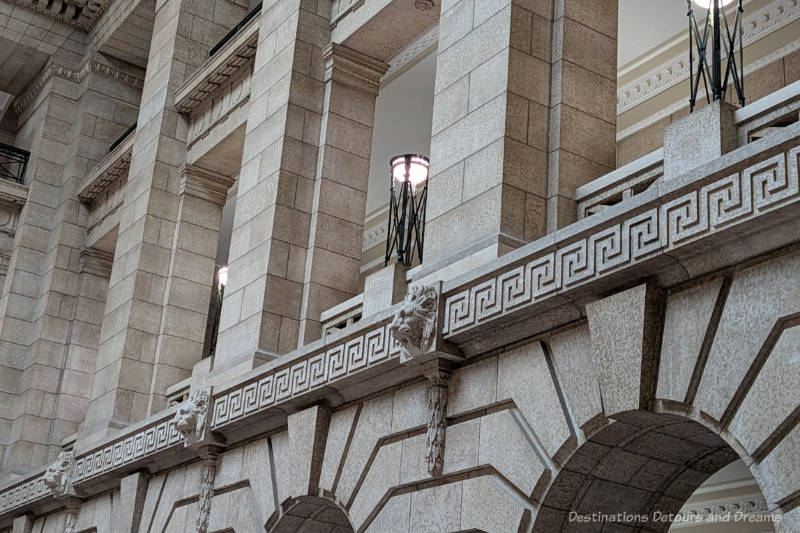
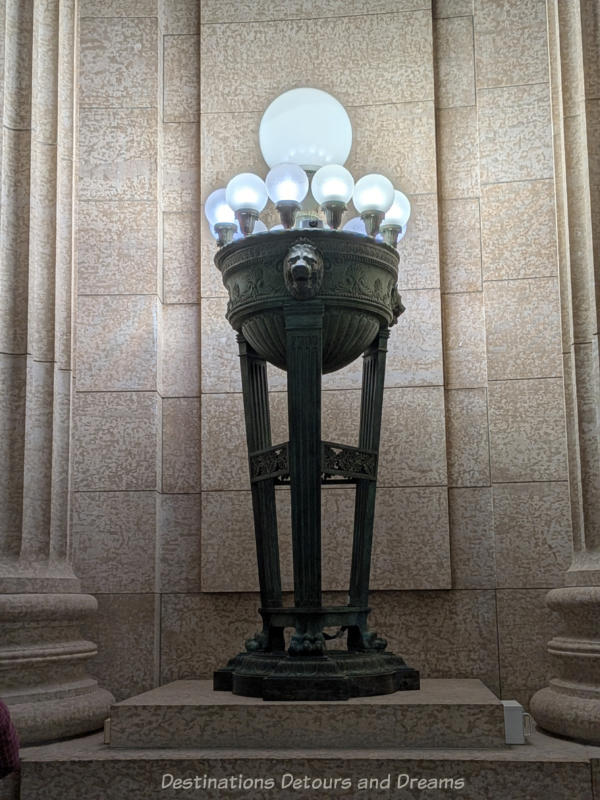
One of the things a guide is likely to mention is the recurring use of the number thirteen. The balustrade in the Rotunda measures 13 feet in diameter. There are 13 bulbs in the Rotunda lamps. There are 39 steps in the Grand Staircase: 3 sets of 13. Ancient Greeks and Romans believed the number 13 was bad luck and hoped that by honoring it they could escape its curse.
Hermetic Code and Freemasonry Symbols
For architectural historian Dr. Frank Albo, the symbolism in the building went deeper. He started studying the building in 2001, exploring the Freemason and Hermetic influence on the design of the building. He described the building as a modern reconstruction of King Solomon’s temple containing secrets of Freemasonry “hidden in plain sight.” Those symbols involve geometry, astrology, and alchemy. Building architect Frank Worthington Simon was a member of the Freemasons, a secret society that believed architecture had the capacity to reform the soul.
In 2007, the Winnipeg Free Press published the Book The Hermetic Code: Unlocking One of Manitoba’s Greatest Secrets by authors Carolin Veseley, Buzz Currie, and Frank Albo. The book contained Albo’s findings and interpretation of the symbols in the Manitoba Legislative Building.
For a number of years, starting in 2009, Dr. Albo conducted Hermetic Code Tours through the building. I took one of these tours and found Dr. Albo to be an enthusiastic guide, as excited to the share the building’s secrets as if it had been the first time he’d revealed them. In addition to pointing out elements of the building, he talked about how he discovered the secrets: time spent measuring every inch of the building, being stopped by security guards in the middle of the night when he was inspecting a statue on the grounds in his pyjamas, and joining the Freemasons himself in order to understand the building.
Dr. Albo no longer lives in Manitoba and these tours no longer run. The guided tours offered by the provincial government are excellent, but they do not get into the Freemasonry connection and symbols. If you are interested in that, you will need to research on your own. Following are a few points of interest from the book and the tour I took several years ago.
- On one of the sphinxes atop the pediment at the front Albo discovered the name of an ancient Pharaoh, Thutmose III, believed by some to be the founder of Freemasonry.
- It isn’t only the number 13 that can be found numerous times throughout the building. The numbers 5 and 8 are also prevalent. Numbers 5, 8, and 13 are part of the Fibonacci sequence, in which each number is the sum of the two preceding numbers in the sequence. As you progress through the sequence, the ratio of two successive numbers approaches the golden ratio, a special number equal to approximately 1.618. The golden ratio is frequently found in art and architecture, and appears in the Parthenon and the Pyramids.
- Albo noted the appearance of the number 666 in the building. The length and width of the building are both 666 feet. The room that houses the grand staircase in the middle of the building is exactly 66.6 feet in width and 66.6 feet in length. Although we now associate that number with the devil, Dr. Albo says it does not mean that in the Hermetic Code. It is associated with the sun.
- The Lieutenant-Governor’s Reception Room, used on state occasions to receive visiting royalty and foreign dignitaries, has the same measurements as the inner sanctum of King Solomon’s temple. Dr. Albo likened it top the holiest of holy rooms in a temple.
- Dr. Albo says the iconic statue of the Golden Boy is the Greek god Hermes, the father of occult philosophy and patron of the Freemasons. Hermes acts as the messenger between the gods and mortals. According to Albo, he is perfectly positioned as the alchemic fifth essence, surrounded by the four elements of Earth, Air, Fire and Water.
Manitoba Legislative Grounds
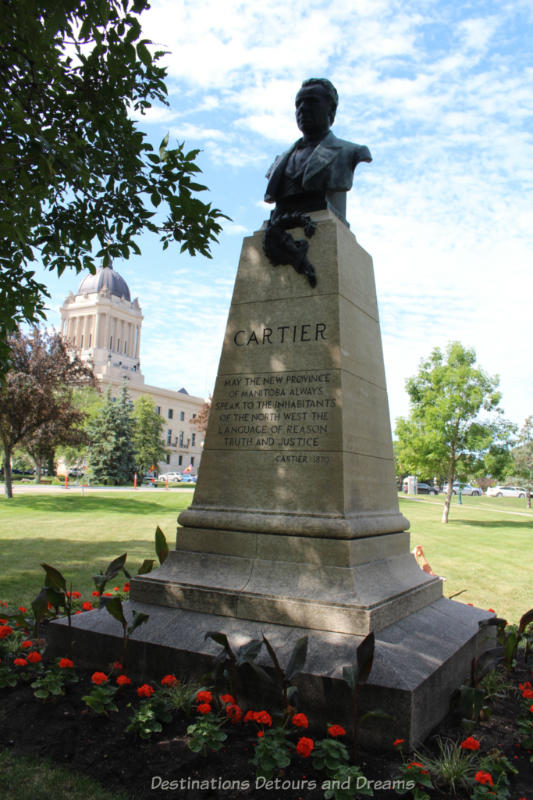
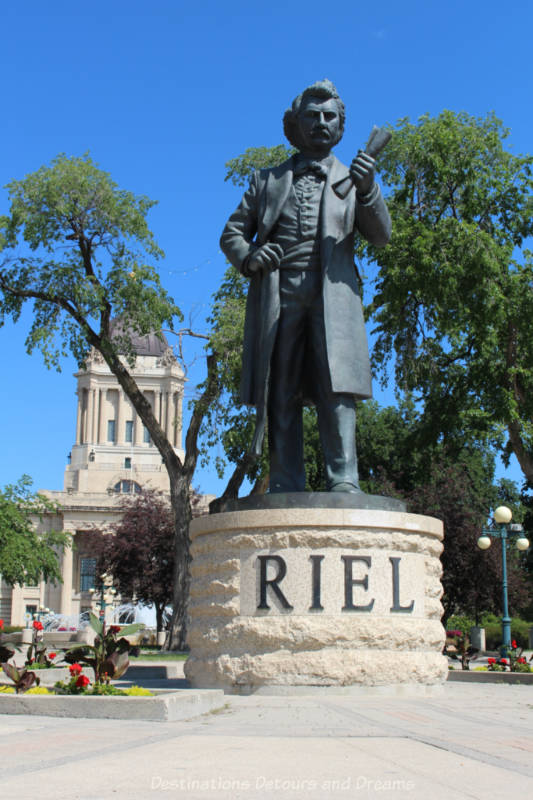
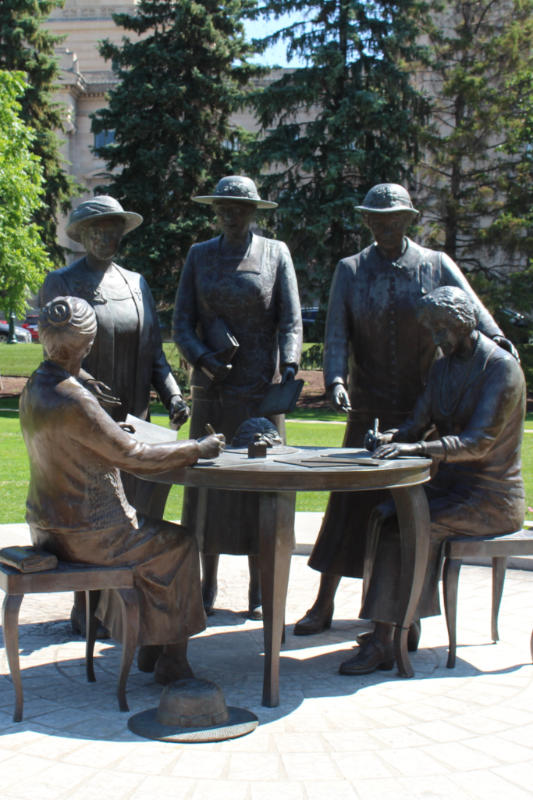
The scenic grounds around the building contain large areas of lawn, garden beds, a fountain, and many sculptures and statues commemorating Manitoba’s history and historic persons.
Visiting the Manitoba Legislative Building
Free guided tours of the building are available in English and French. Tours run on an hourly basis throughout July and August. They are offered at specific days and times the remainder of the year. See the Manitoba Legislative Building Visitor Page for the schedule.
You can reserve a spot on a tour in advance or get into a tour as a walk-up. I’d recommend you reserve in order to ensure a spot. Tour group size is limited to 30 people.
The tour takes 45 minutes to an hour. You will see most or all of the places I’ve highlighted in my overview of the interior.
There is an elevator in the building. I have been on a tour with a group of seniors where some walked up the stairs and others took the elevator to join the rest of the group.
You will need to have photo id and go through security (airport-like screening) to enter the building.
The grounds can be visited at any time.
There are a variety of links on the Manitoba Legislative Building Visitor Page containing more information about the building and the grounds.
Never miss a story. Sign up for Destinations Detours and Dreams free monthly e-newsletter and receive behind-the-scenes information and sneak peeks ahead.
PIN IT
A stately structure. Enjoyed all the detail you provided about it’s features, especially the story of the path the “golden boy” took to get there and how it acquired its shine.