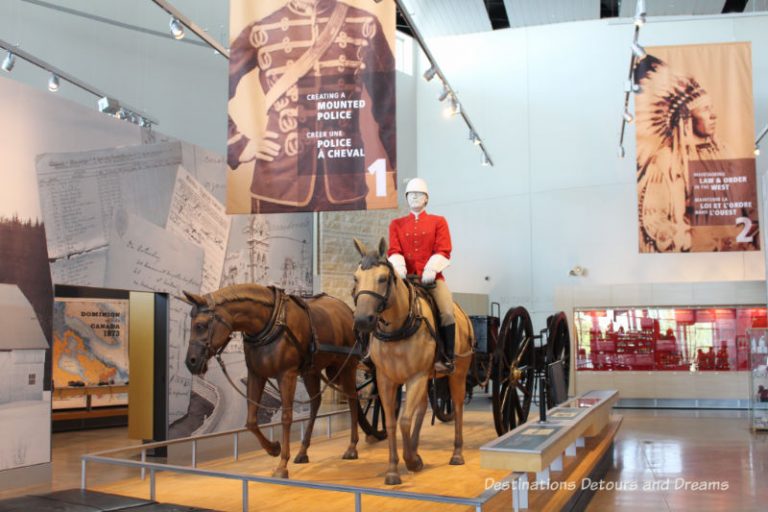

Explore Winnipeg’s Exchange District
National Historic Site neighbourhood featuring heritage buildings, arts, entertainment, boutique shops, and eateries in the heart of Winnipeg, Manitoba, Canada
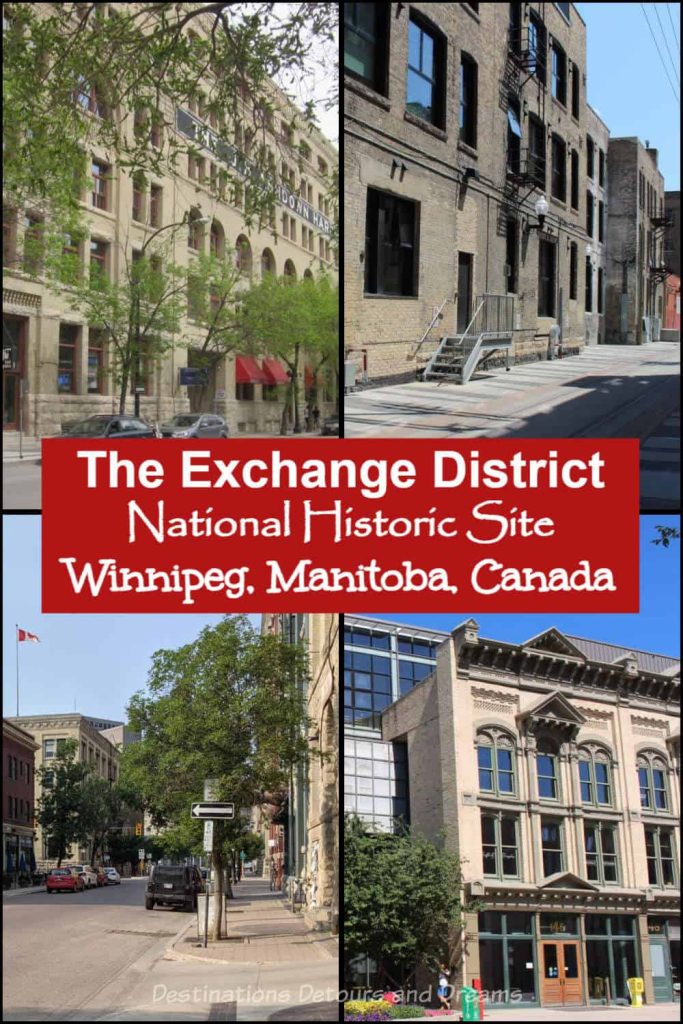
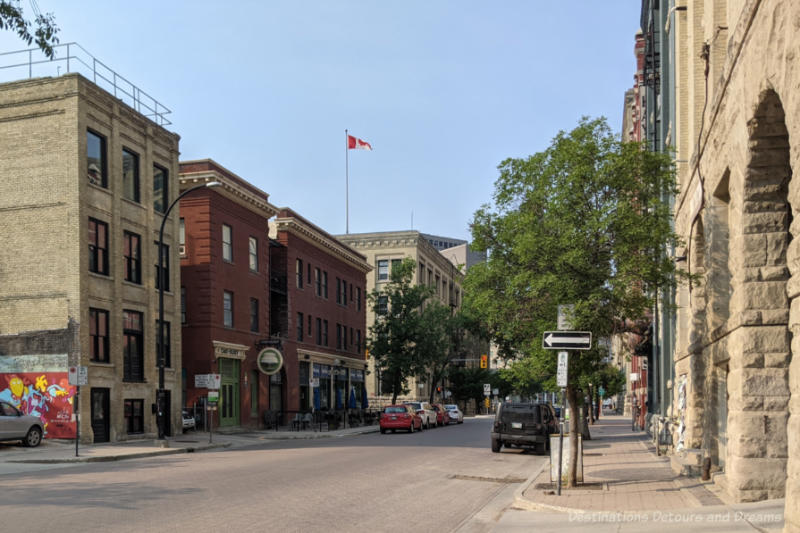
The Exchange District in Winnipeg, Manitoba, Canada is an arts and cultural neighbourhood in the heart of downtown. As the place where the city began, it is steeped with history, but it is also alive with modern-day activities and attractions.
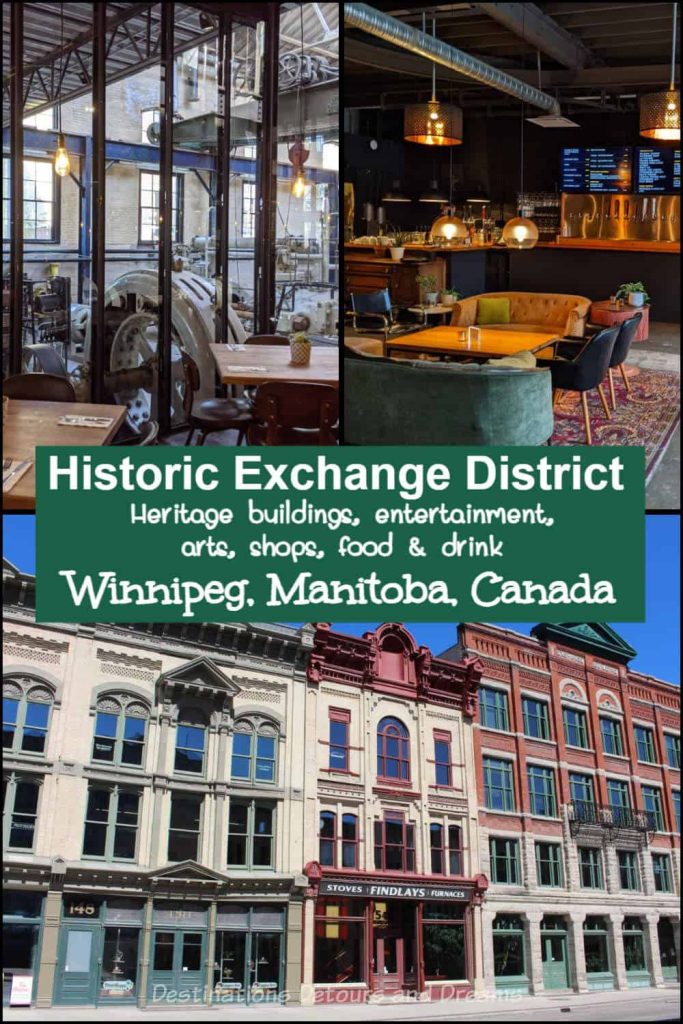
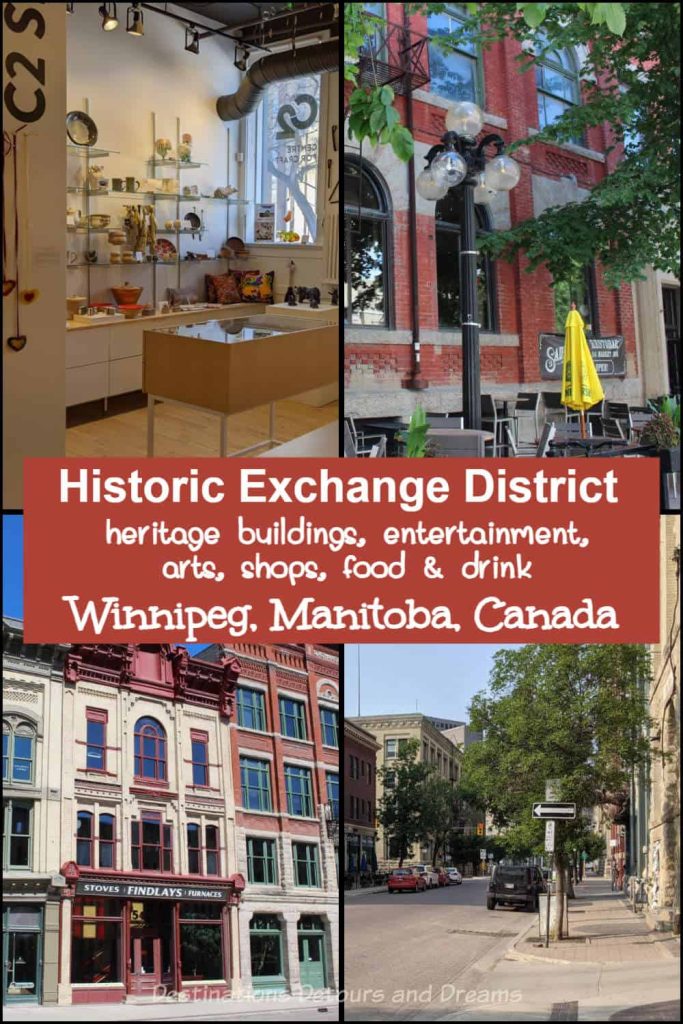
The 20-square-block area is a National Historic site containing about 150 heritage buildings constructed between 1880 and 1920. Inside those buildings, you’ll find art galleries, artist studios, unique shops, restaurants, bars, and cafés. It is home to Winnipeg’s theatre district, and a focal point for many festivals. Many of the heritage buildings also now contain modern loft apartments and condos.
The Exchange District is often broken down into two sub-areas: the East Exchange and the West Exchange. They are divided by Main Street, a busy, major thoroughfare. The approximate boundaries of the East Exchange are the Disraeli Bridge, Waterfront Drive, William Stephenson Way, and Main Street. Approximate boundaries of the West Exchange are Ross Avenue, Main Street, Notre Dame Avenue, and Adelaide Street.
I’ve written about a few individual attractions within this area in the past. In this post, I provide an overall summary of the area, an area definitely worth spending some time in when visiting Winnipeg.
TABLE OF CONTENTS
Winnipeg Exchange District History
Located just a block or two north of Winnipeg’s current downtown, the Exchange District was the heart of the city when it developed in the late 1880s.
The railway brought immigrants to the city and helped define Winnipeg as the “Gateway to the West.” What is now known as the Exchange District, especially the East Exchange area, contained many warehouses. Spur lines connected the warehouses to main railway lines running through the city.
The city became the centre of the growing Canadian agricultural economy. The Winnipeg Grain and Produce Exchange organized in 1887. The downtown wholesale/warehouse district became known as the Exchange District after its founding. By the 1920s, more than half of the world’s wheat sales were completed at Winnipeg’s Grain Exchange.
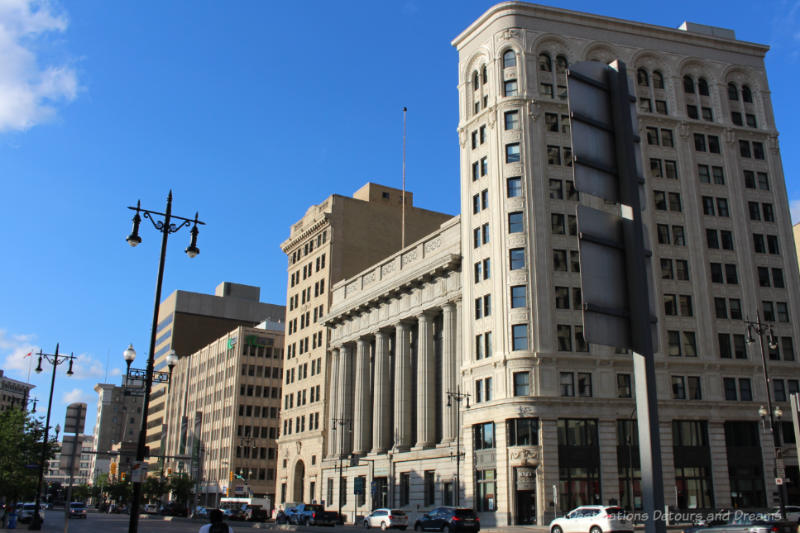
By 1905, Winnipeg was the fastest growing city of its size in North America and gained the nickname “Chicago of the North.” Several financial institutions established headquarters in Winnipeg in the early 1900s. A part of Main Street became known as “Bankers’ Row” because of a cluster of 20 banks on the street.
The Exchange also became the city’s publishing core. By the end of World War I, three daily newspapers were located on McDermot Avenue: The Manitoba Free Press, the Winnipeg Telegram, and the Winnipeg Tribune. Winnipeggers often gathered on the street to read the latest news posted on the wall or shouted through megaphones. Today, a plaque on the Telegram building at 70 Albert Street honours this history.
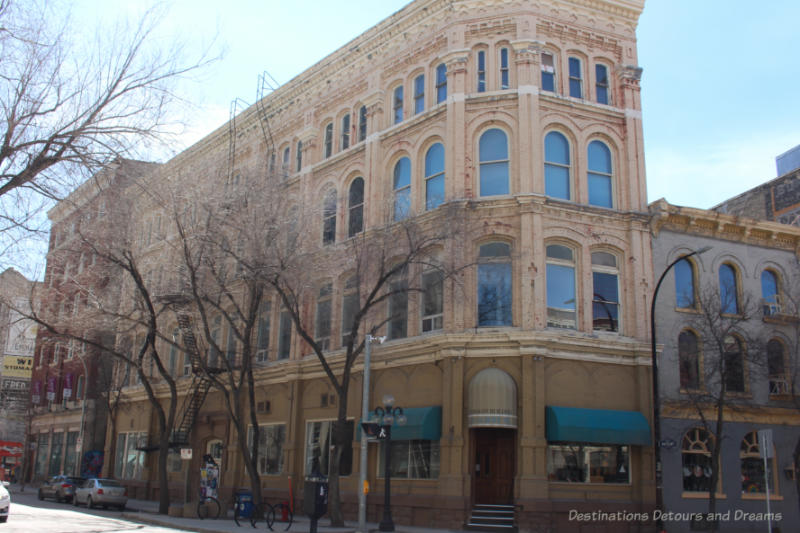
People gathered here to hear the news during the six-week General Strike of 1919. That bitter labour dispute paralyzed and polarized the city and remains a significant point in Winnipeg’s history and Canada’s labour history. The Exchange District was at the heart of that strike and many events occurred within it. You can read more about the strike and ways to explore that history today in my post Touring 1919 General Strike History in Winnipeg, Canada.
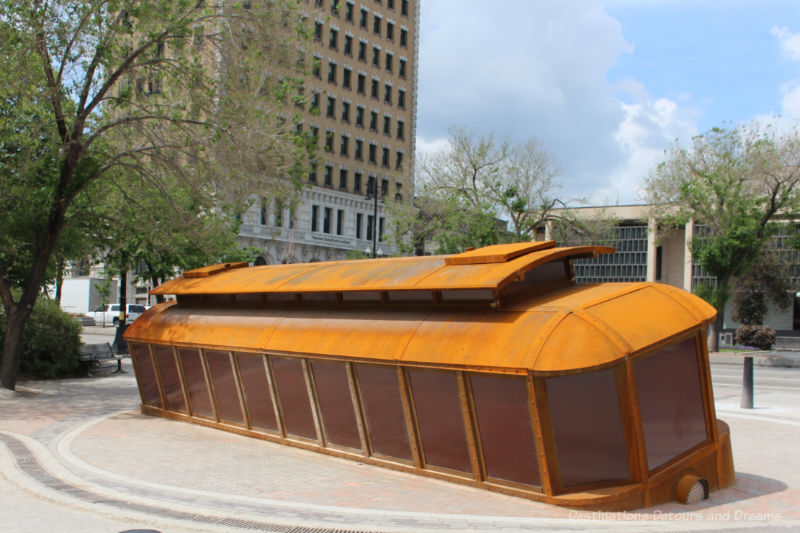
A public art work titled Bloody Saturday commemorates an event during the strike when a confrontation occurred between police and thousands of strikers and their sympathizers, who gathered in downtown Winnipeg in a silent parade to protest the arrest of strike leaders. Angry protestors turned over a street car in front of City Hall. The sculpture by Bernie Miller and Noam Gonick sits near where that conflict occurred in Pantages Plaza on the corner of Main Street and Market Avenue beside Pantages Theatre.
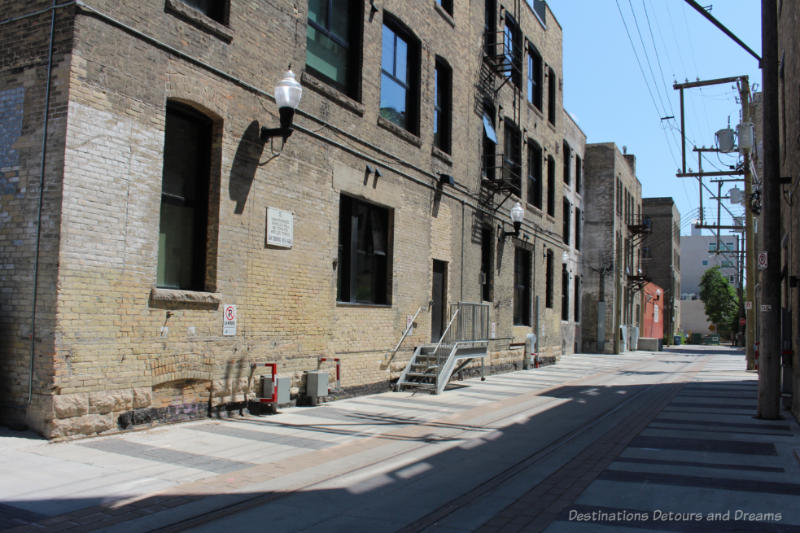
When fighting erupted, people fleeing the violence sought refuge in the nearby narrow Elgin Street, only to become trapped. A 10-minute conflict led to 27 casualties. The alley became known as Hell’s Alley. The section of Elgin Street immediately off Main Street now contains a building, but a block away, you can get a sense of what it must have felt like to be in that alley. It is the only place in the Exchange where you can still see the remnants of the spur lines that once ran from the warehouses.
City growth slowed after World War I and the opening of the Panama Canal. The canal lessened the importance of the railway in getting goods to western Canada. Wheat prices declined. Other western Canadian cities were growing and no longer relied as heavily on Winnipeg-supplied goods. When the economy picked up again, businesses focused on building new a few blocks south-west. The Exchange began a slow decline. In the latter half of the twentieth century, the area became neglected and rundown.
A 1960s revitalization plan saw the building of the Centennial Concert Hall, the Planetarium, and the Manitoba Museum at the expense of a few existing buildings. A number of the heritage buildings now still standing may have been lost had the full plan not turned out to be cost-prohibitive.
Restoration efforts began in the 1970s. The 1980s through the early 2000s saw a period of rejuvenation and investment. Today, the Exchange District is a vibrant area with plenty to see and do amid an exceptional collection of architecturally-interesting heritage buildings.
The restored heritage buildings are a visual reminder of the area’s history. You will find historic marker plaques with more detail on many of the buildings. Another aspect of history is visible in the ghost signs found throughout The Exchange. Ghost signs are the fading hand-painted advertising signs painted on the outside of buildings from the 1890s to the 1960s. Winnipeg has a rich collection of these signs, the majority of which are located in The Exchange District. For more detail, read about my experience taking a tour of Winnipeg Exchange District Ghost Signs.
Winnipeg Exchange District Architecture
The heritage buildings within The Exchange reflect a variety of architectural styles. During Winnipeg’s boom years, roughly between 1880 and 1920, the area attracted some of the continent’s best architects who designed buildings in styles ranging from Chicago School to Beaux-Arts, Richardsonian Romanesque, and Art Deco. The area today contains one of the largest and best-preserved collection of heritage buildings in North America. Buildings in the Brutalism style were added in the 1960s. Modern skyscrapers sit at the edge of the district.
I am going to highlight only a few of the architectural gems to give you a flavour of the area.
Although you’ll find a variety of architectural styles, three notable styles dominate: Romanesque, the Chicago School, and Brutalism (a form of Modernism).
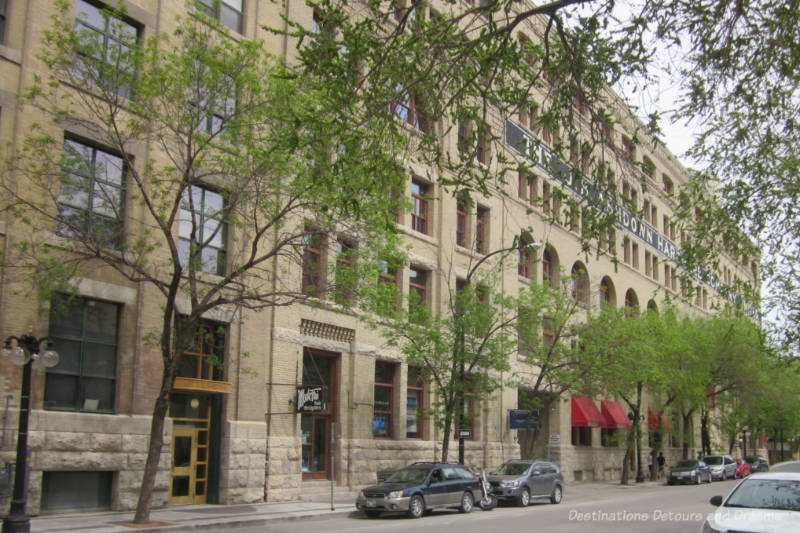
Romanesque, a style popular from the 1870s to the 1900s, features classical Roman forms, such as arches, and asymmetrical facades. Two sub-styles you’ll find in the Exchange District include Richardson Romanesque, which has bold, wider arches and large pieces of quarried stone, and Victorian Romanesque, which boasts multi-coloured exteriors, semicircular arches, and ornate decorations. The Ashdown Warehouse, pictured in the History section above, is an example of Richardson Romanesque style.
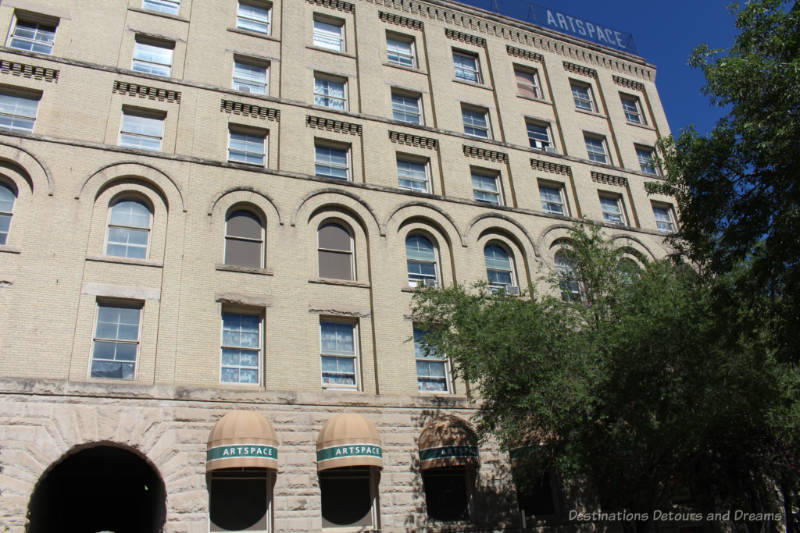
Another fine example of a Richardson Romanesque warehouse was constructed at 100 Arthur Street in 1900 for the Gault Brothers Company Ltd., a Montreal-based dry goods wholesaler. It was originally a four-storey building, but two additional stories were added in 1903. The six-storey annex added along the south wall at the same time now appears to be part of the same building. Today, the building is Artspace, home to nearly two dozen arts and cultural organizations working in film, video, publishing, visual and new media arts, theatre, and photography.
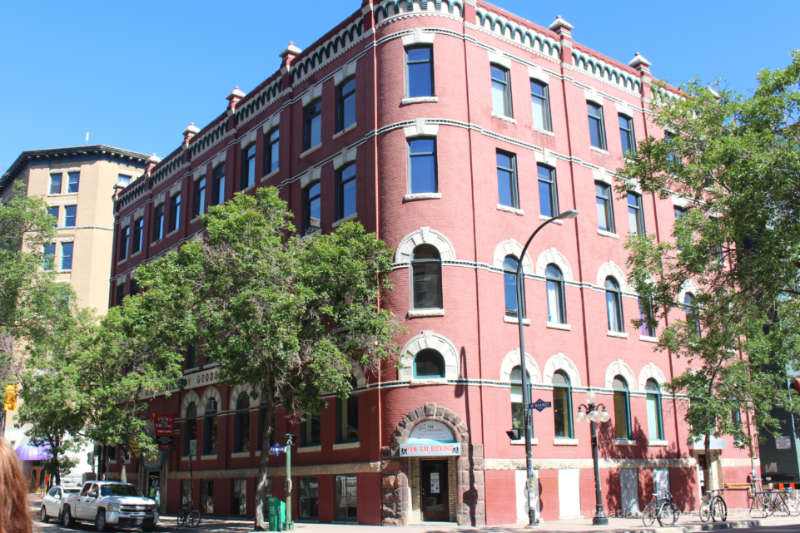
The Chicago School or architecture, prominent in the late 1880s and 1890s, introduced steel-frame construction and featured masonry cladding and large plate-glass windows. Terra cotta was often used in place of stone ornamentation.
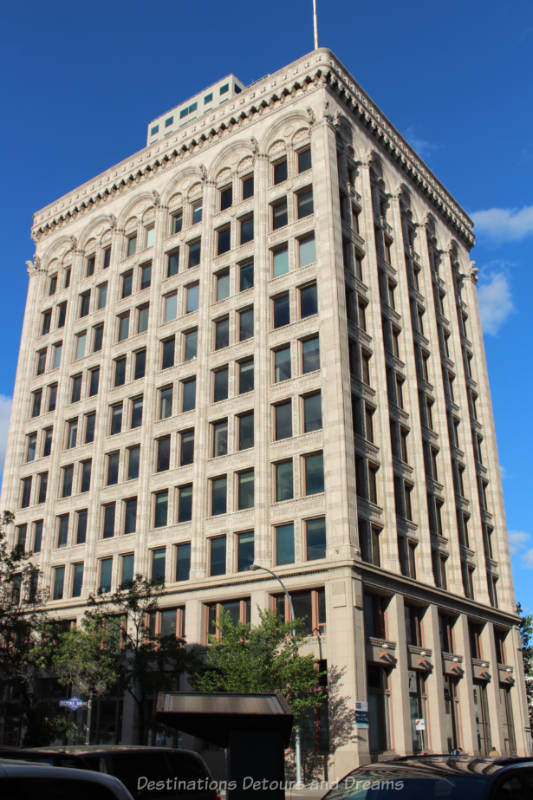
The Electric Railway Chambers Building at 213 Notre Dame Avenue is one of Winnipeg’s most elegant early skyscrapers and an example of Chicago style. Built in 1913, the building features a granite base, a terra cotta exterior, Italian Renaissance motif adornments, and 15 sculptural lions below the cornice.
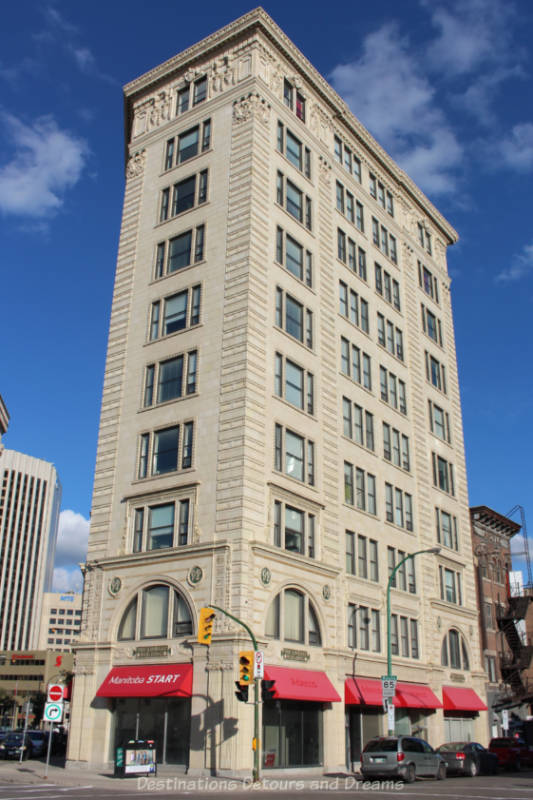
According to the Winnipeg Architecture Foundation, the Lindsay Building at 228 Notre Dame Avenue, constructed in 1911-1912, offers the most effusive use of terra cotta in the city. It has a trapezoidal shape because of the irregular dimension of the property. It is here where the original settler lots of long narrow strips along the Red River to the east met the same type of lots along the Assiniboine River to the south
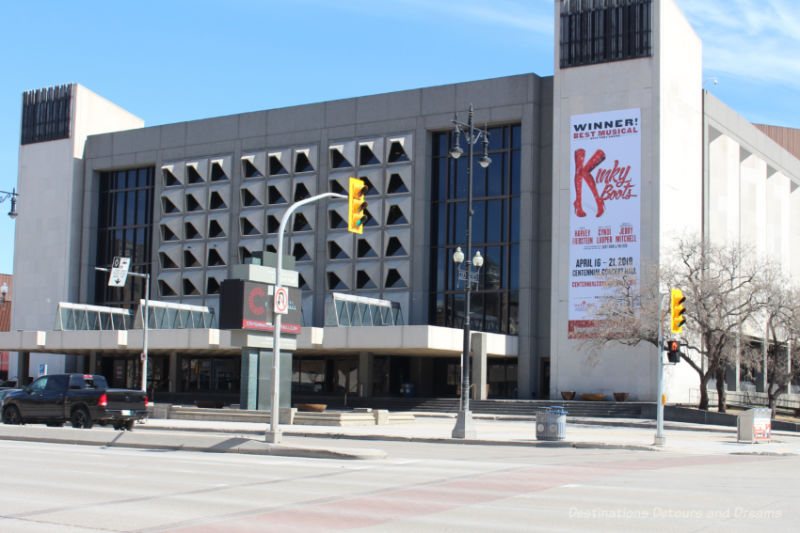
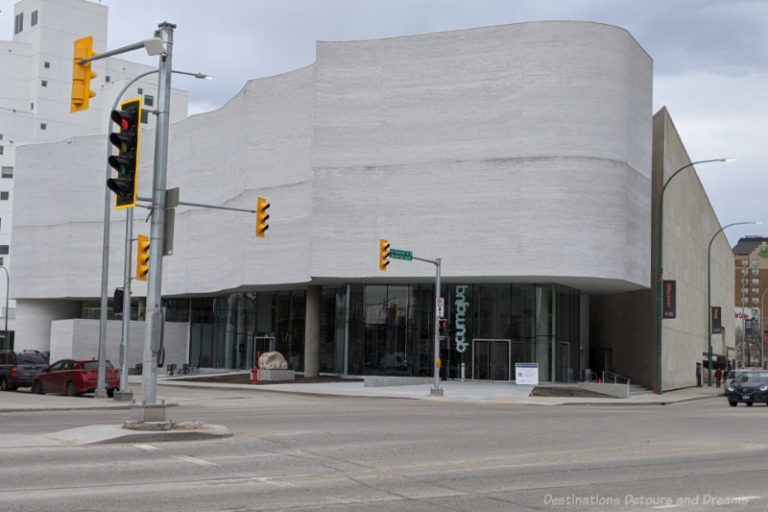
Brutalism emerged in the late 1960s to early 1970s and featured raw, exposed concrete, geometric forms, and minimal ornamentation. The Centennial Concert Hall (555 Main Street) is an example of Brutalism architecture in The Exchange.
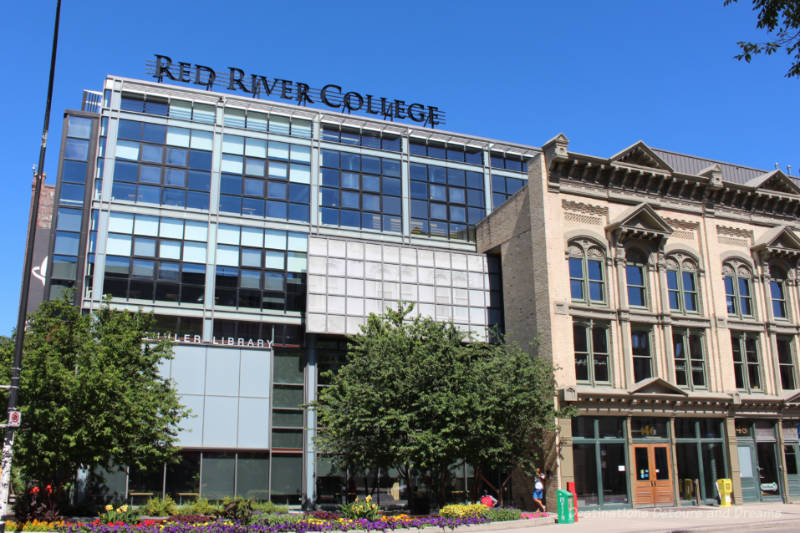
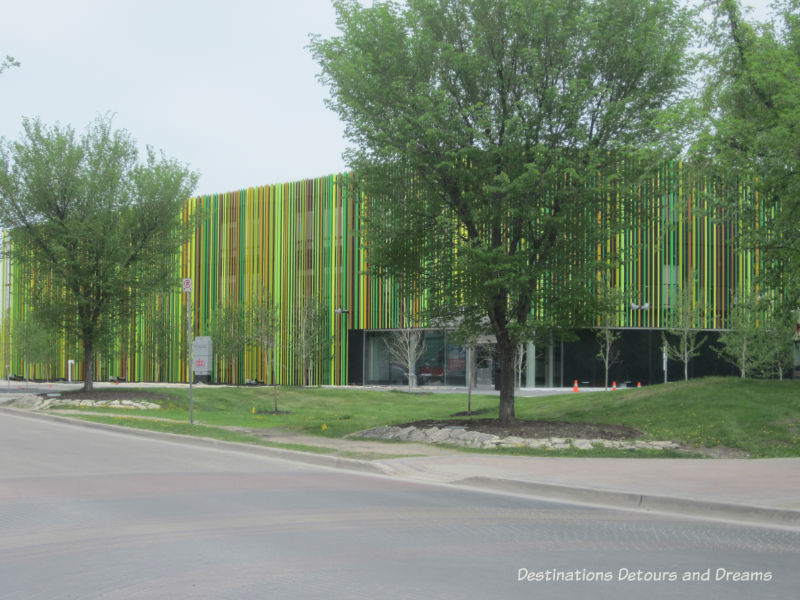
Many of the heritage buildings have undergone restorative efforts and have been adapted for new uses. In some cases, old architectural elements have been combined with modern design to create stunning new buildings. My favourite example of this is the RRC Polytech Roblin Centre (160 Princess Street) at the western end of The Exchange. Storefronts from the late 1800s/early 1900s form one side of the building with a modern structure of glass-paned walls at one end.
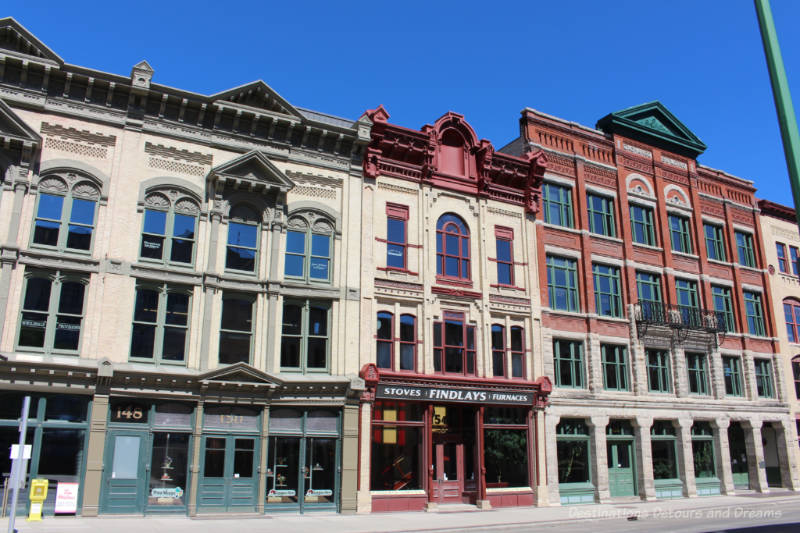
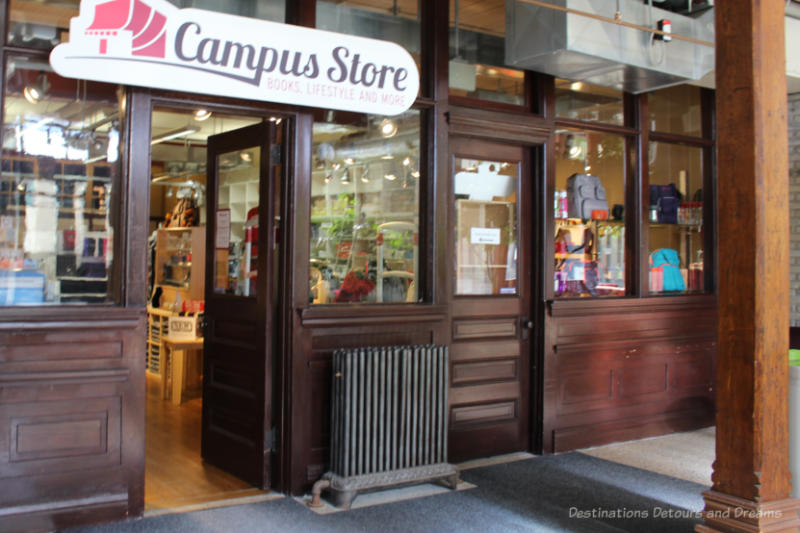
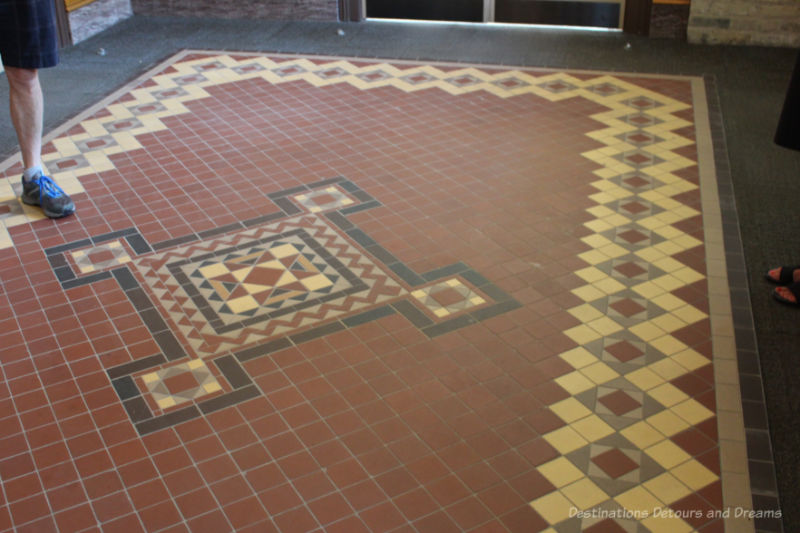
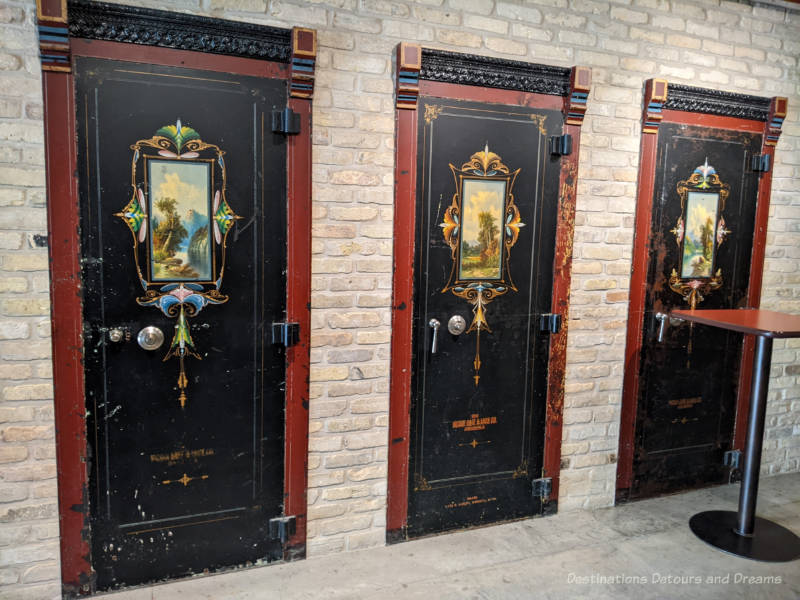
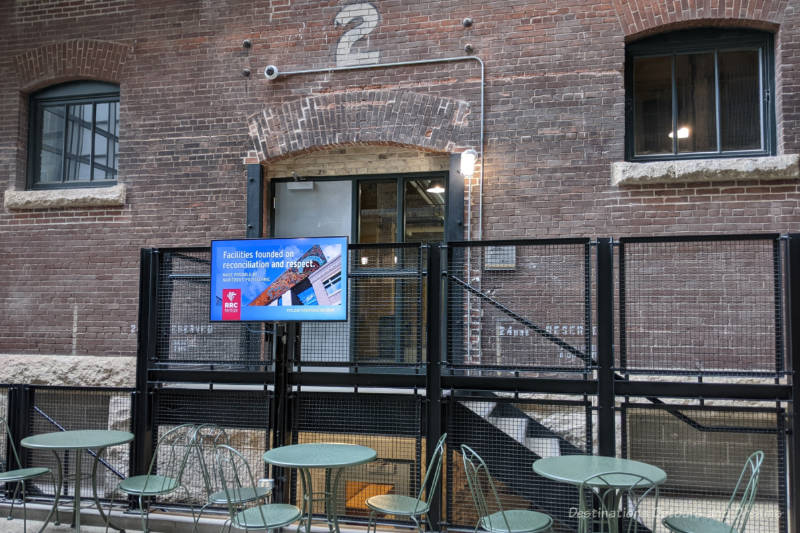
In addition to masonry construction imported material such as terracotta, red brick, granite and sandstone, you’ll also find the use of local Tyndall stone in some of the buildings. Tyndall Stone is a form of mottled, cream-coloured dolomitic limestone quarried northeast of Winnipeg. A feature is the presence of visible fossils in the mottled stone. You can go fossil hunting in the heart of a city!
The architecture and heritage buildings in The Exchange are a big part of the reason this area is often used as a film set. It stands in for other cities and time periods. I’ve walked through the area to find one street lined with 1960s cars featuring New York license plates as a film shoot was in progress. I’ve also seen a store front decorated for Christmas with fake snow out front in the middle of summer.
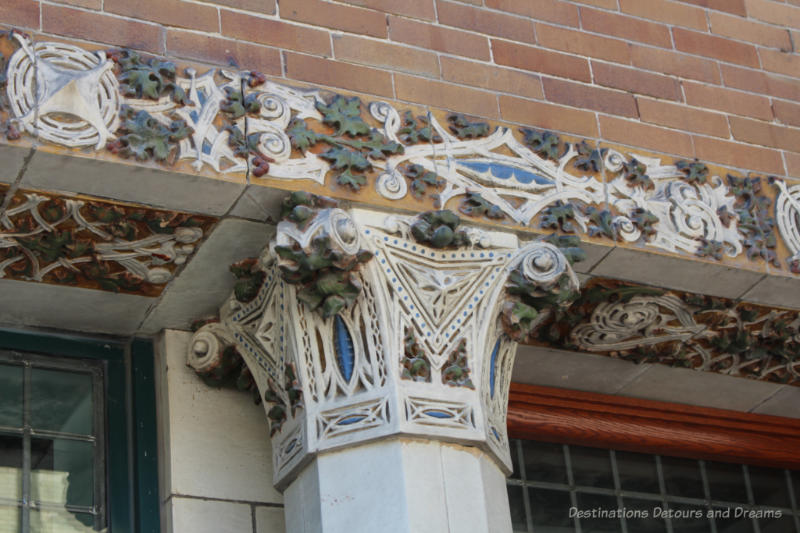
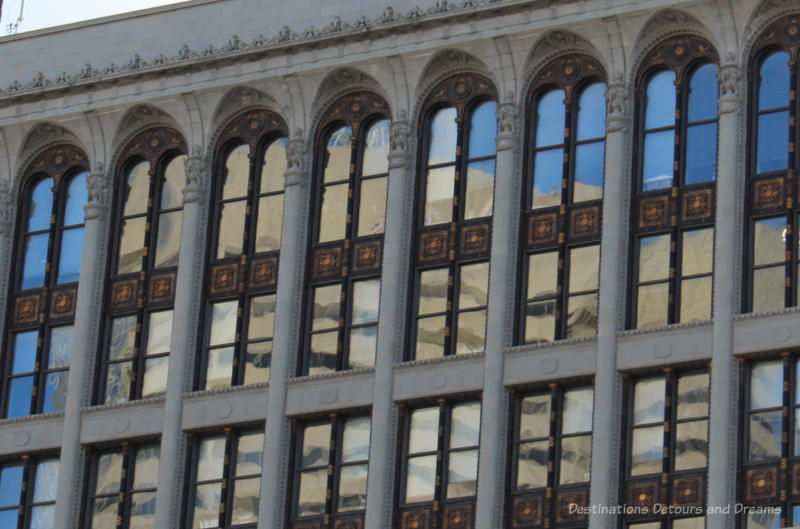
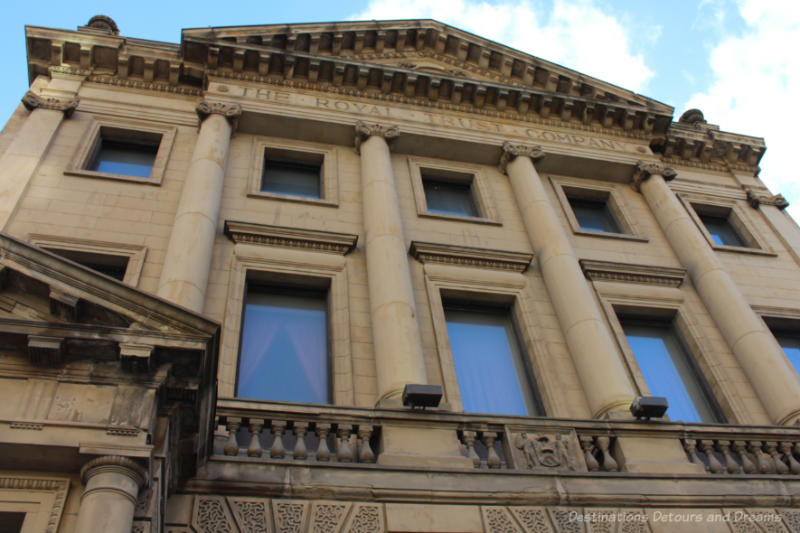
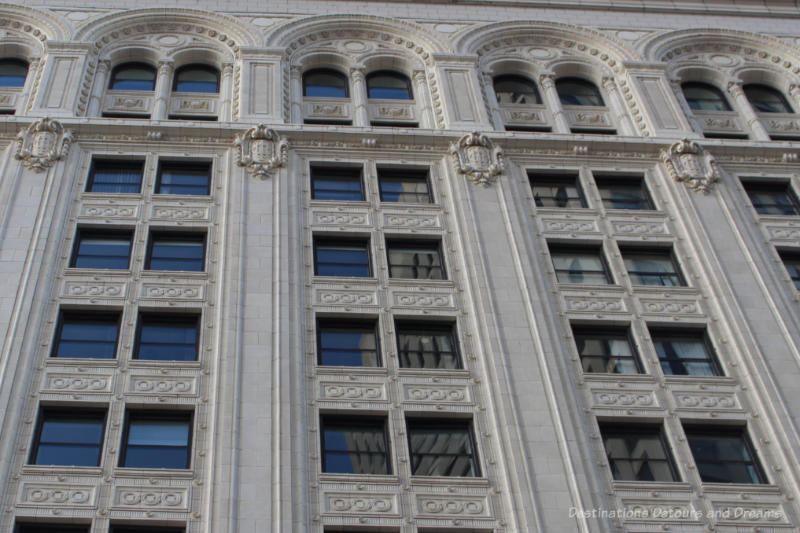
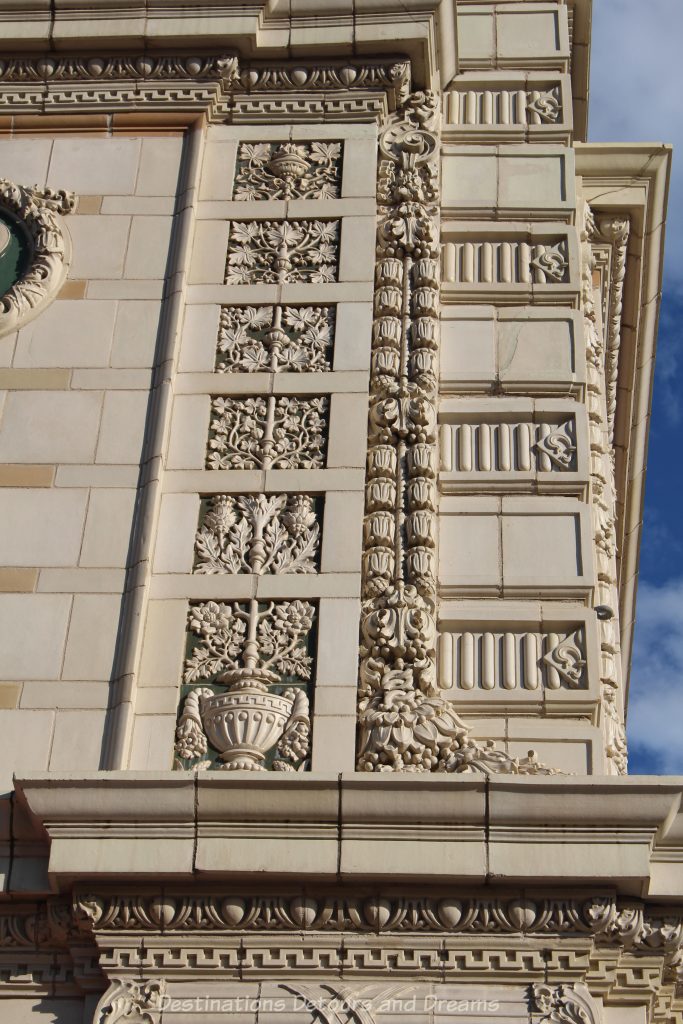
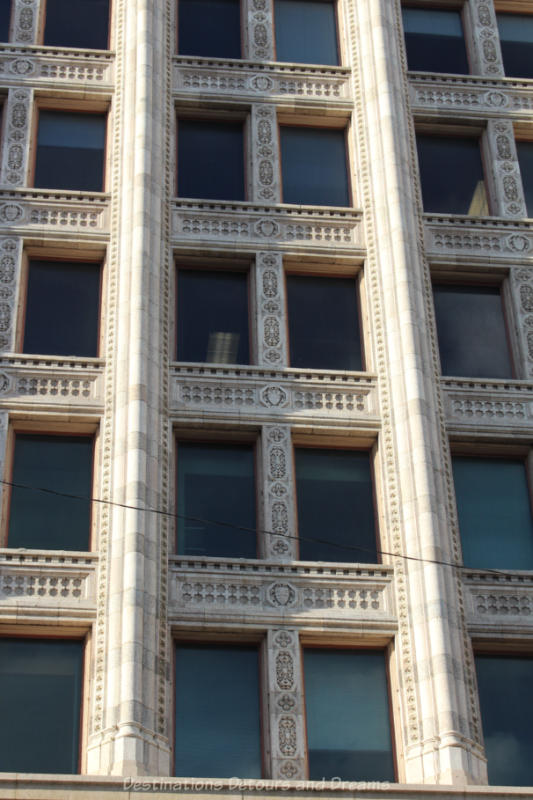
The detail and ornamentation of many of the heritage buildings merits close looks. The photos below provide a sampling of what you might see.
Winnipeg Exchange District Arts and Entertainment
The Exchange is home to many unique galleries and creatives spaces and is an entertainment hub.
You can check The Exchange District BIZ website for a listing of art galleries. I will highlight just a few. Mayberry Fine Art (212 McDermot Avenue) is a gallery and national Canadian art dealer that has been operating for over 50 years. Urban Shaman Gallery (203-290 McDermot Avenue) is an Aboriginal artist-run centre and a nationally recognized leader in contemporary Indigenous art. Located in the same building, Canadian Plains Gallery (B1, 290 McDermot Avenue) is an agency that promotes the highest quality art of Manitoba’s premiere Indigenous Artists.
Not only are there public galleries in The Exchange. Many artists have studio spaces here. Some open their private studios to the public monthly for First Fridays. On the first Friday of each month, galleries, artist-run centres, studios, shops and museums stay open late to welcome the public. The list of artist studios varies from month to month. Each month also features an Art Talk and guided Art Walk. See the First Fridays website.
In the area, you’ll also find another creative space. North Forge Fabrication Lab, one of North America’s largest fabrication and rapid prototyping facilities. The amount of high-end equipment available to members at the non-profit lab for a reasonable membership fee needs to be seen to be appreciated. The facility conducts free weekly tours for the public. See its website for times and registration. A Maker’s Market on the first floor on the main floor sells products made by members.
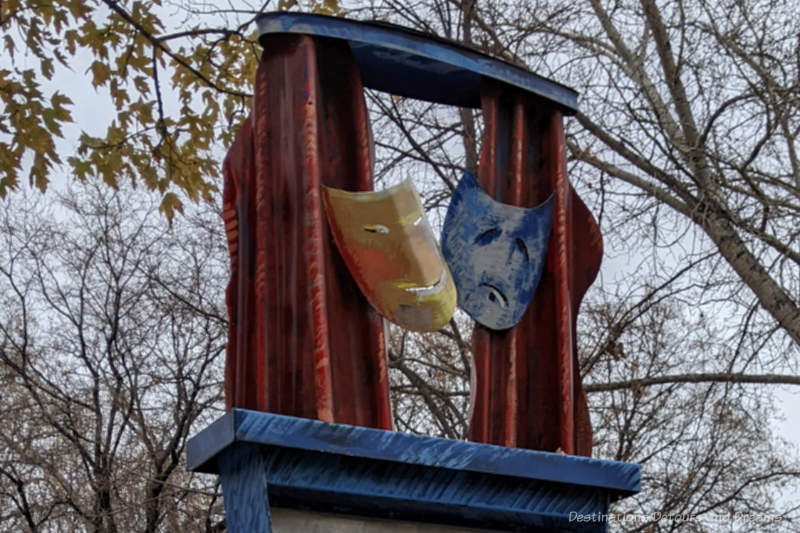
The Exchange contains a Theatre District with a number of venues where you can see live performances.
The Centennial Concert Hall (555 Main Street) is 2,305-seat concert venue in which you can see a variety of performances that include symphonies, ballet, opera, concerts, and travelling musicals and other plays.
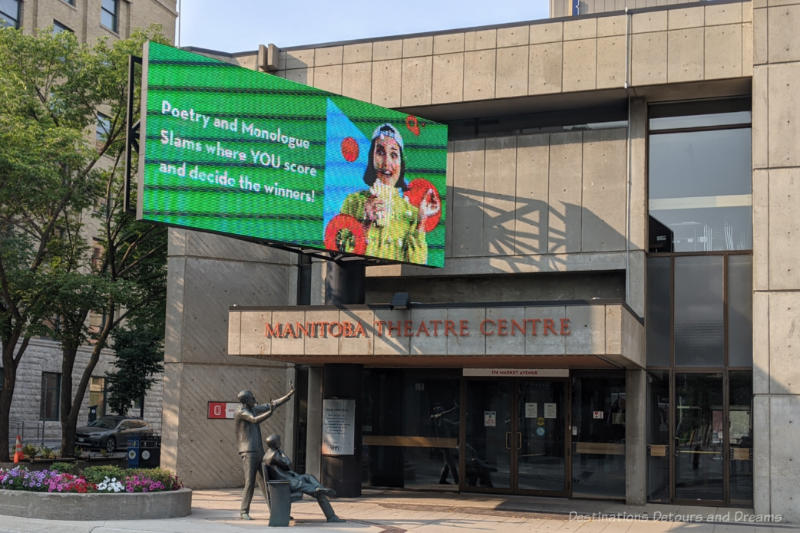
The Royal Manitoba Theatre Centre exists to celebrate the widest spectrum of theatre art. Its 785-seat John Hirsch Mainstage auditorium (174 Market Avenue) was built in 1970 and was designated a National Historic Site of Canada in 2009 because it is an excellent expression of small-scale Brutalist architecture in Canada. The Tom Hendry Warehouse (140 Rupert Avenue) is its second stage and offers a more casual and intimate theatre experience.
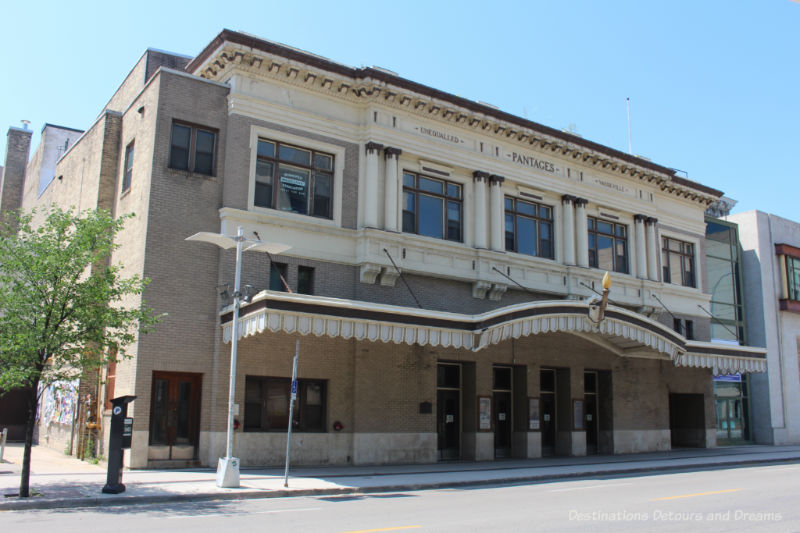
Although the above-mentioned venues were created in the latter part of the twentieth century, Winnipeg’s theatre history goes back much further than that. Pantages Theatre at 180 Market Street was built between 1913 and 1914 and was the first reinforced concrete Vaudeville house of its size in North America. The National Historic Site has been closed since 2018, but the Winnipeg Symphony Orchestra released plans in 2025 for what it hopes will become a new home for some of its performances.
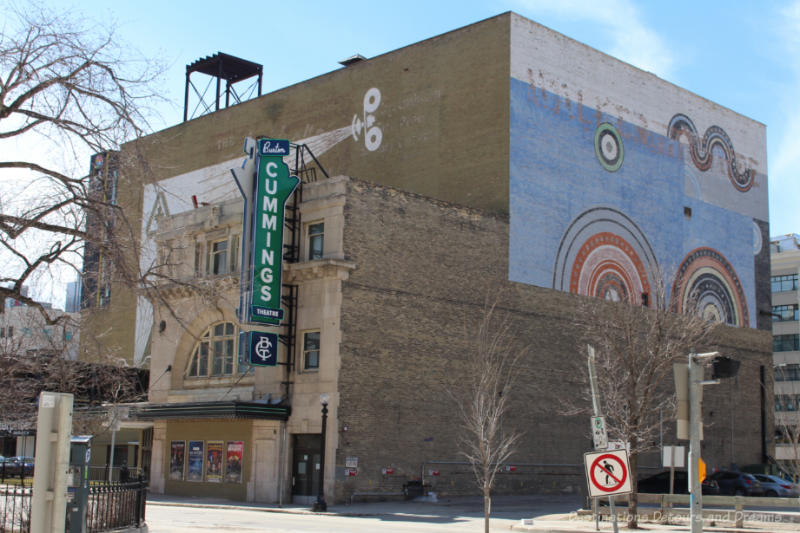
The Burton Cummings Theatre for Performing Arts (364 Smith Street), located at the southern edge of the Exchange District, hosts a variety of performances, including concerts, plays, and comedy shows. It was constructed in 1906–1907 as the Walker Theatre and is both a Manitoba Provincial Heritage Site and a National Historic Site. The theatre brought ballets, operas, and Broadway-style shows to Winnipeg. It was also the location of nationally important rallies, including meetings of the women’s suffrage movement and labour movements. After being used as a cinema from 1945 to 1990, it reopened in 1991 as a home for the performing arts with the building’s original architectural features having been restored. It was renamed after Winnipeg-born musician Burton Cummings, former lead singer of the Guess Who.
Another entertainment venue in The Exchange is the Dave Barber Cinemateque, which is operated by the Winnipeg Film Group and located in the Artspace building at 100 Arthur Street. It screens the best in Canadian and world cinema while highlighting Winnipeg filmmakers and underrepresented artists in its intimate 85-set theatre. Many showings also feature locally-made shorts, panel discussions, and Q&As with guest artists.
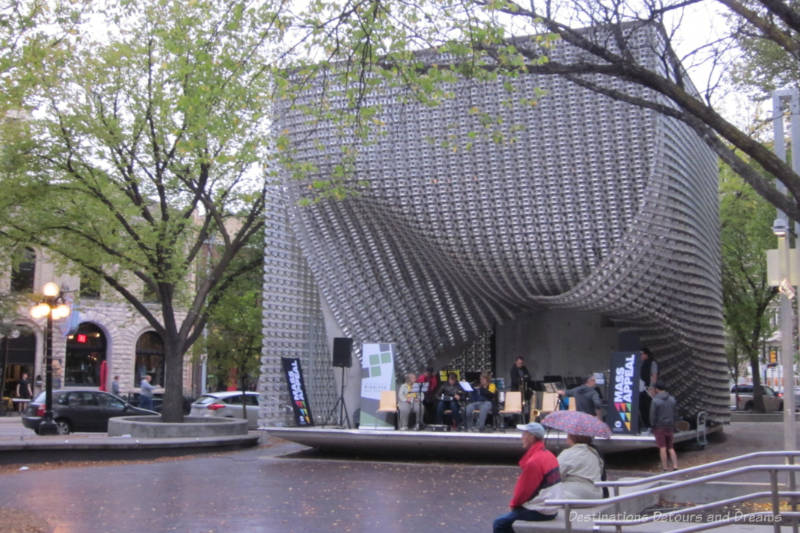
The Cube, a modern stage in Old Market Square (275 Bannatyne Avenue), is the site of many concerts and festivals throughout the summer months. The Exchange District is the heart of many Winnipeg festivals with performances at the Cube as well as several venues in the area. The Exchange District becomes a buzz of activity during the festivals. Three major annual festivals are TD Winnipeg International Jazz Festival, Winnipeg Fringe Festival, and Soca Reggae Festival. See The Exchange District BIZ festival page.
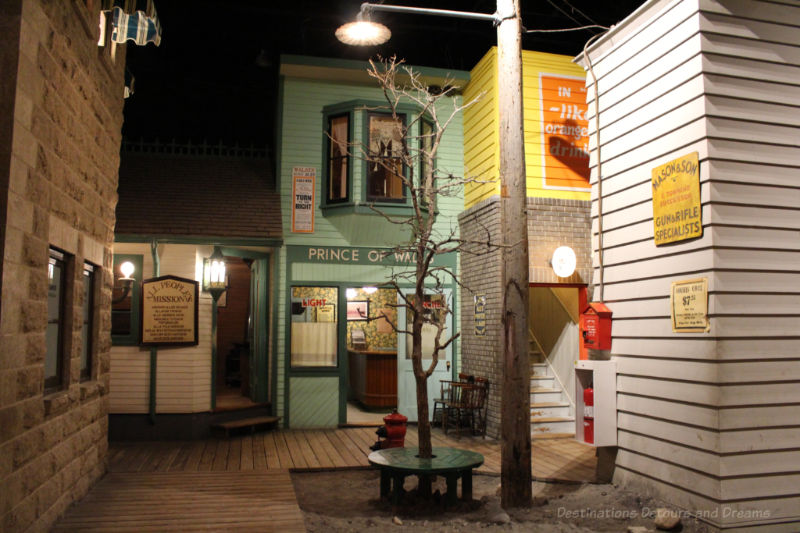
There are also several museums in the district. The most notable is the Manitoba Museum (190 Rupert Avenue), which is actually three museums in one–Planetarium, Science Gallery with many interactive exhibits, and the Museum Galleries, which showcase both the natural and human history of Manitoba’s diverse landscapes. Read more in my posts Man and Nature in Manitoba Museum Galleries and Manitoba Museum Science Gallery.
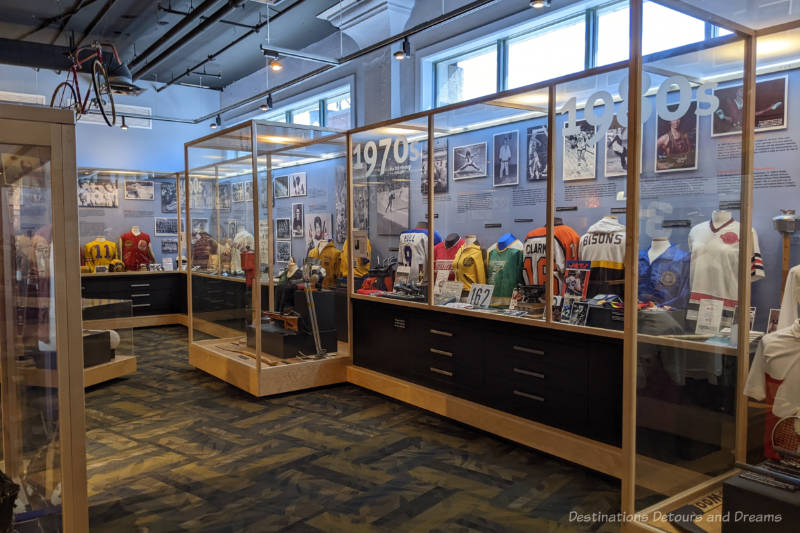
The Manitoba Sports Hall of Fame (145 Pacific Avenue) honours Manitoba athletes throughout history. Permanent exhibits contain memorabilia from a wide variety of sports grouped by decade. The museum also contains temporary exhibits pulled from a collection of 10,000 items.
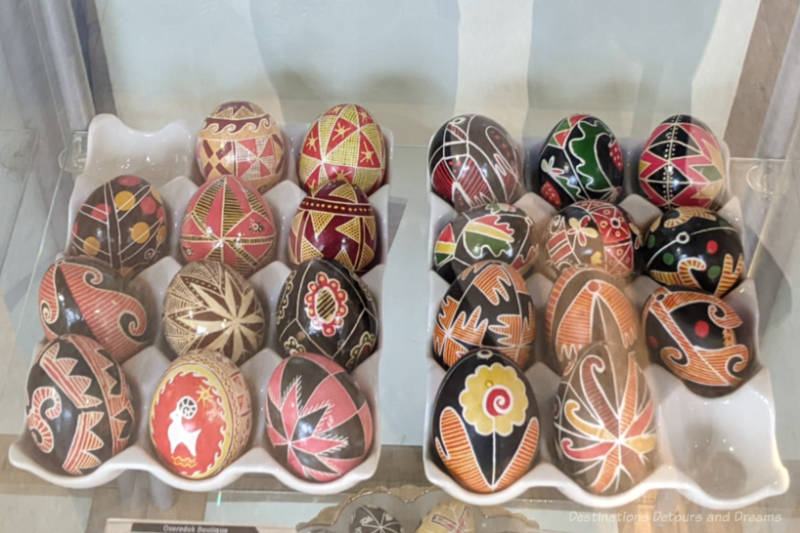
Oseredok Ukrainian Cultural and Education Centre (184 Alexander Avenue East) shares Canadian Ukrainian cultural experience through changing exhibitions in its museum space. Exhibitions may include art, textiles, clothing, and/or folk art. Oseredok houses one of the largest pysanka (Ukrainian decorated Easter eggs) collection in North America. They also offer workshops and presentations.
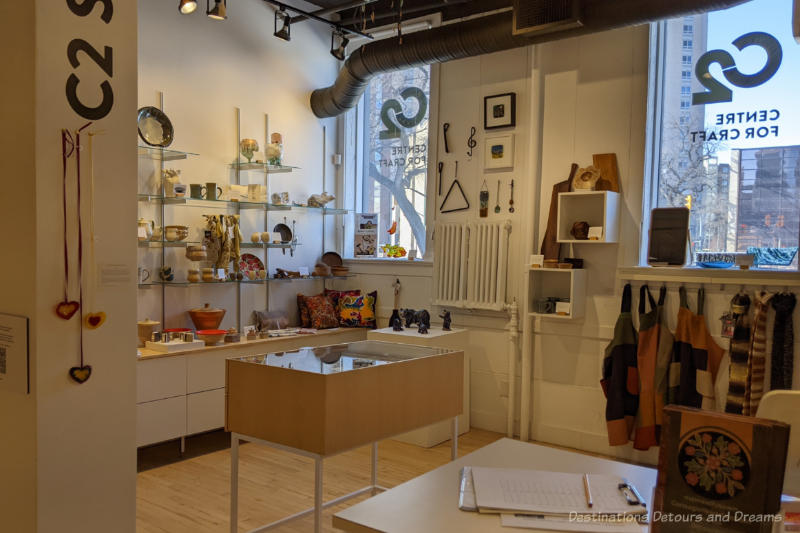
The C2 Centre for Craft, located at the western edge of The Exchange, stages exhibitions featuring the best of traditional and contemporary craft in Manitoba. Read more in my post Manitoba C2 Centre for Craft.
The Costume Museum of Canada (410–70 Arthur Street) celebrates the link between fashion and culture and history with costumes worn by Canadians over the decades. The volunteer-run museum draws from its collection of over 35,000 artifacts to create sporadic themed pop-up exhibits. Displays in its office space, which is generally open to the public a couple of afternoons a week, change every couple of months. See its website for current hours. Read more about the museum in my post Fashion History At The Costume Museum Of Canada.
Winnipeg Exchange District Shopping
There are more than 40 one-of-a-kind independent retailers in The Exchange. Seek out a specific store or wander through the area to browse the stores as you come across them. You’ll find jewelry, used books, toys, vintage and designer clothing, stationery, vinyl records, home décor items, and more. Toad Hall Toys at 54 Arthur Street carries a large selection of unique toys in a store filled with old-world charm. U.N. Luggage at 175 McDermot Avenue carries a great collection of luggage, bags, backpacks, briefcases, and travel accessories. (Writers may want to check out their writing instruments, which includes fountain pens, roller pens, ballpoint pens, and mechanical pencils.) Find an amazing selection of new and used vinyl records, CDs, DVDS, posters, magazines, and books at Into the Music at B-245 McDermot Avenue. Friday evenings often feature live music in the store. Check out the full list of shops at The Exhange District BIZ.
Winnipeg Exchange District Food and Drink
The Exchange District is home to over 50 locally-owned cafés, restaurants, bars, and craft breweries. I am going to highlight only a few, but there are many other excellent choices for food and drink in the area. Visit The Exchange District BIZ website for a fuller list.
Celebrity chef Mandel Hitzer creates multi-cultural fusion dishes at Deer + Almond (85 Princess Street), a restaurant that has appeared on the Canada’s 100 Best Restaurants several times. With the décor and vibe of a British pub, King’s Head Pub and Eatery (120 King Street) offers pub and curry meals, a large selection of local and imported beer on tap, and a variety of other alcoholic and non-alcoholic drinks. Carnaval Brazilian BBQ (270 Waterfront Drive) is a fun place for meat-lovers where you can dine endlessly on various cuts of seasoned beef, pork, chicken, and Brazilian sausage accompanied by traditional Brazilian items and house-baked Brazilian bread.
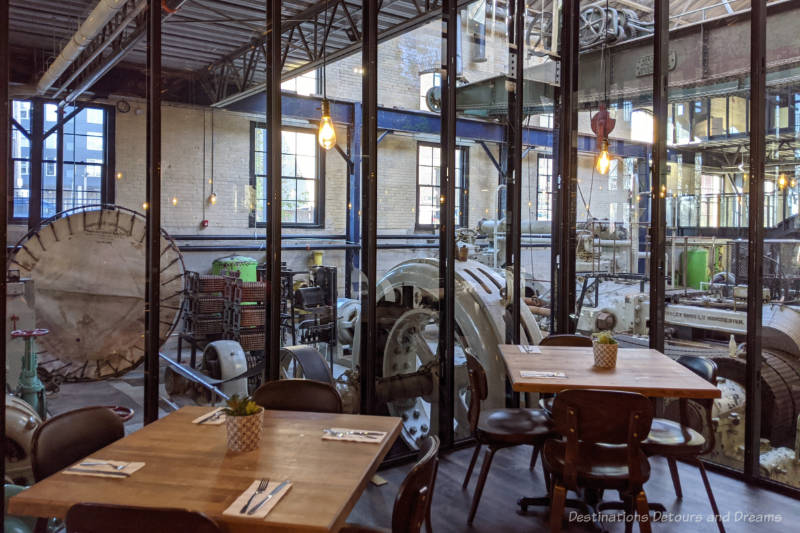
James Avenue Pumphouse (109 James Avenue) is located within an historic pumping house building. The old pumping equipment is visible behind glass walls. Although decorated with vintage fire extinguishers and helmets, the restaurant has a modern, comfortable, sociable vibe. The eclectic menu offers something for everyone. All the meals I’ve had there have been excellent. Read more in my post Historic Pumping Station Eatery in Winnipeg, Manitoba.
Peasant Cookery (283 Bannatyne Avenue), a personal favourite restaurant, offers French-inspired upscale comfort food. It cures its own meats and pickles its own vegetables. Eat at Across the Board Game Café’s licensed restaurant while playing one of the board games from their library of over 1,600 titles. Visit Corrientes Argentine Pizza for delicious empanadas, Argentinian pizza, or Cuban melts.
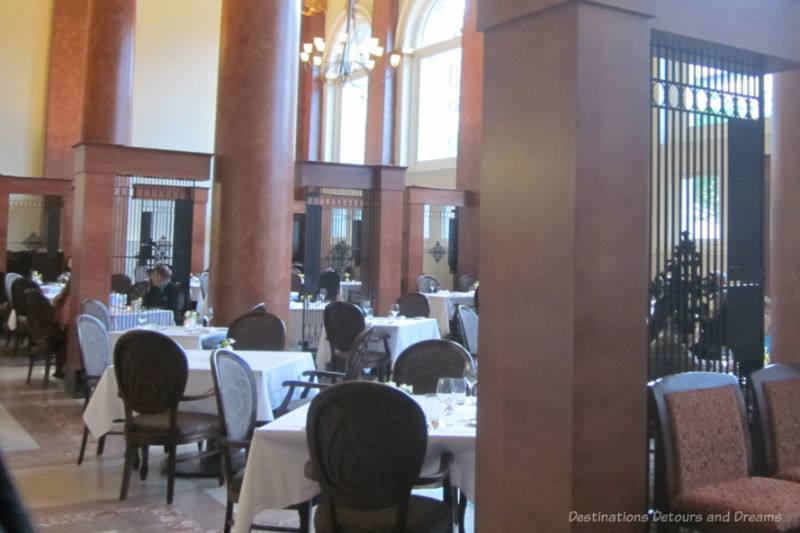
For a little difference experience, go to Jane’s (504 Main Street), which features upscale dining with food prepared and served by RRC Polytech’s culinary and hospitality students while instructors guide and look on. The elegant dining room was the former grand banking hall of the Union Bank. Note that the restaurant only operates during fall and winter terms. Reservations are required. Read more in my post Jane’s Not So Plain Dining.
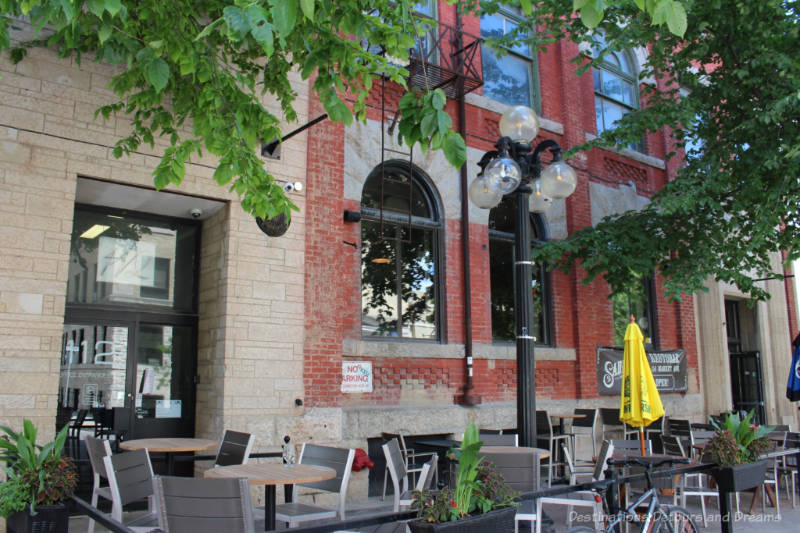
There are several coffee shops as well as a couple of craft breweries. The taproom of Little Brown Jug craft brewery (336 William Avenue) is located in an old livery stable and has become a unique meeting place with an open concept allowing viewing into the brewing area. They host a number of event nights and have a large patio space open during the summer. The comfortable, welcoming taproom of Nonsuch Brewery (145 Pacific Avenue), a craft brewery specializing in Belgian-style ales, offers its beers on taps, snacks, house-made charcuterie, sandwiches, sharable plates, as well as wine by the bottle, gluten-free craft vodka seltzers, and a variety of non-alcoholic drinks. Read more in my post A Visit To Nonsuch Brewing Taproom In Winnipeg, Manitoba.
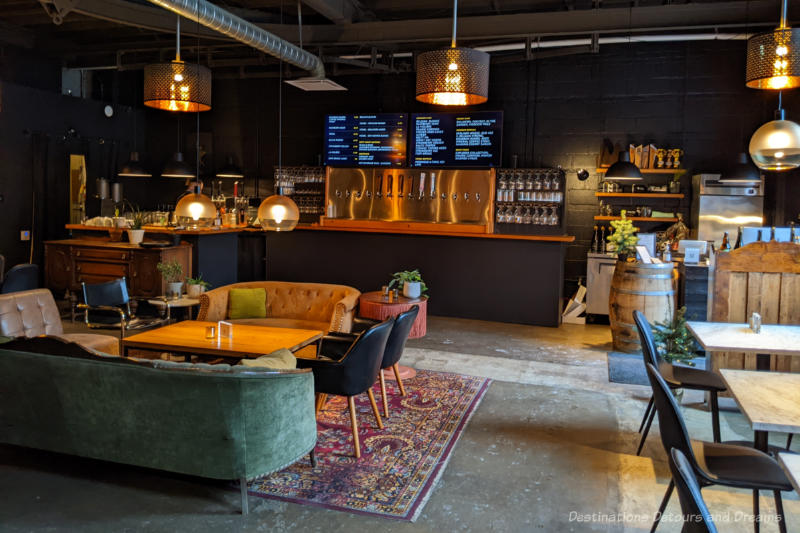
Patent 5 (108 Alexander Avenue) is a craft distillery located in a former livery stable that dates to 1904. It makes gin, vodka, liqueur, and ready-to-serve cocktails. Its cocktail bar is furnished with reclaimed stained glass, doors, wood paneling and other items from the historic Oak Room at the St. Regis Hotel. Distillery tours area available at select times at a cost. Patent 5 also offer cocktail-making classes.
Visiting The Exchange District In Winnipeg
The Exchange District is centrally located and within walking distance of downtown hotels. The Mere Hotel is located in the district itself, on its eastern end.
The area is easily reached via public transit. For those who choose to drive to the area, The Exchange District BIZ Plan Your Visit page contains information on parking. Note that payment for on-street parking must be made via a telephone application (PayByPhone). As you drive through the area, be aware of the protected bike lanes and exercise caution. Bicycle parking is available for cyclists.
The Exchange District BIZ offers a variety of walking and food and drink tours during the summer. Tripvia, a company providing self-guided smart phone audio tours, has a theatre tour that explores the historical buildings, theatres & film sets in The Exchange. Check Winnipeg Ghost Walk for any scheduled Exchange District ghost walk tours. These are often scheduled during the month of October.
Tourism Winnipeg has created a curated walk that connects downtown, The Exchange District and Old St. Boniface. You can download a printable map from The Loop website or follow the interactive map on your phone.
If you choose to explore on your own, look for historical plaques on buildings. You will also find decals with QR codes on a selection of buildings. The QR codes take you to webpages with information about the buildings. More information about this can be found on the Winnipeg Architecture Foundation QR Code Tour page.
Following is a map showing the location of the places I have mentioned in this post.
- Across the Board Café
- Artspace (and Dave barber Cinematheque)
- Ashdown Warehouse
- Burton Cummings Theatre
- C2 Centre for Craft
- Canadian Plains Gallery
- Carnaval Brazilian BBQ
- Centennial Concert Hall
- Corrientes Argentine Pizzeria
- Costume Museum of Canada
- Deer + Almond
- Electric Railway Chambers Company
- Hell’s Alley
- Into The Music
- James Avenue Pumphouse Food & Drink
- Jane’s
- King’s Head Pub & Eatery
- Lindsay Building
- Little Brown Jug
- Manitoba Museum
- Manitoba Sports Hall of Fame
- Mayberry Fine Art
- Mere Hotel
- Nonsuch Brewing Co.
- North Forge Fabrication Lab
- Old Market Square (and The Cube)
- Pantages Playhouse Theatre
- Oseredok Ukrainian Cultural & Education Centre
- Patent 5 Distillery & Tasting Room
- Peasant Cookery
- Royal Manitoba Theatre John Hirsch Mainstage
- RRC Polytech Roblin Building
- Stovel Block (aka Kay Building)
- Telegram Building
- Toad Hall Toys
- Tom Hendry Warehouse Theatre
- U.N. Luggage
- Urban Shaman Gallery
Note: Several of the places mentioned in this post are featured in my book 111 Places in Winnipeg That You Must Not Miss: C2 Centre for Craft, Canadian Plains Gallery, Dave Barber Cinematheque, Hell’s Alley, Into The Music, James Avenue Pumphouse, Jane’s, North Forge Fabrication Lab, RRC Polytech Roblin Building, Manitoba Sports Hall of Fame.
Never miss a story. Sign up for Destinations Detours and Dreams free monthly e-newsletter and receive behind-the-scenes information and sneak peeks ahead.
PIN FOR LATER